
If you’re trying to analyze markets across borders, compare competitors globally, or simply understand what real users see in different parts of the world, relying on a single location just won’t work.
That’s where geo-targeted web scraping comes in. Instead of guessing what your audience experiences, you can view the exact content users see in any location.
And here’s the best part: you don’t need to build all that infrastructure yourself. Today, many teams rely on GEO-aware proxy platforms like Decodo, which provide massive distributed IP pools across countries, cities, and even mobile carriers. That way, every request looks like it’s coming from a real user.
What is Geo-Targeted Web Scraping?
With geo-targeted web scraping, you get to choose the location your traffic appears to come from.
Your scraper routes traffic through that region. And the website responds with the localized version of the page, just like it would for a real user there.
Think about how much difference that makes:
- A hotel might show different pricing in London vs. Bangkok
- An e-commerce site may hide or reorder product listings based on region
- Some items may be in stock in one country and unavailable in another
- Language can automatically switch depending on location
- Delivery options and timelines may change
- Even taxes and fees can vary dramatically
Without geo-targeting, you miss all of that nuance.
How Geo-Targeted Proxies Work
Here’s the simple flow:
Your Scraper Sends Request
You tell your scraper to fetch a page, but make it look like the user is in Paris, not New York.
A Proxy Node in that Region Forwards the Request
Your request is routed through a proxy server physically (or virtually) based in that city, country, or carrier network.
The Website Sees a Real Local IP
To the website, it looks just like it’s coming from a normal user in that location, not from a foreign data center or scraping tool.
Localized Content is Returned
Pricing, availability, currency, delivery options, everything now reflects what local users actually see.
The Proxy Passes the Data Back to You
Clean, localized content lands right in your scraper, ready for analysis.
Pro Tip: Websites don’t just look at your IP address; they also consider network identity, like:
- ASN (Autonomous System Number)
- ISP reputation
- Connection type
And the best picks here are residential and mobile proxies, as they tend to have the highest level of trust, because they exactly look like legitimate everyday users.
Types of Geo-Targeted Proxies
Let’s break it down simply:
Residential Proxies
These come from real household internet connections, the same kind of IPs regular people use at home.
That makes them:
- Highly trusted
- Very natural-looking
- Much less likely to be blocked
Best for:
- E-commerce data
- Competitive pricing
- Marketplaces
- Any site that blocks data-center traffic
Mobile Proxies
These route traffic through 4G/5G mobile carrier networks. Mobile traffic has the highest trust rating on the internet because IPs are constantly rotating across thousands of real users.
That means:
- Extremely low block rates
- Ideal for mobile-first or app-like platforms
- Perfect when websites are extra protective
Best for:
- Mobile-optimized sites
- Social platforms
- Highly protected environments
However, these are the most expensive options.
Datacenter Proxies
These come from cloud servers.
So, they’re:
- Very fast
- Very affordable
- Perfect for scraping public, low-risk data
But here’s a tradeoff:
Websites can more easily detect them, meaning higher block or CAPTCHA rates on protected sites.
Best for:
- Open directories
- Public listings
- Basic research
- High-volume scraping
The Golden Rule: Match Real User Behavior
Ask yourself:
- Do real users browse from home? Use residential
- Do users come from mobile carriers? Use mobile
- Is the data public and low-risk? Datacenter is perfect
Why Geo-Targeting Matters in Real-World Scraping
Let’s have a look at some real-world examples:
- True Regional Pricing Analysis: Geo-targeting lets you see what each market really pays, instead of guessing.
- Competitor Monitoring: You get to see what your competitors are doing promotionally as a highly localized playbook.
- Ad & SEO Verification: It helps you verify whether the ads are actually running, which keywords can trigger them, and how rankings differ across cities or rankings.
- Access to Region-Restricted Sites: It helps ensure you’re accessing and analyzing data as a legitimate local user would.
- Compliance & Authenticity: Geo-targeting supports honest representation. Just region-appropriate access that reflects genuine user behavior.
A Quick Note on Scale
At scale, accuracy depends on more than just geography. Factors like ASN diversity and fresh rotating IP pools all play a role in keeping traffic natural and trustworthy.
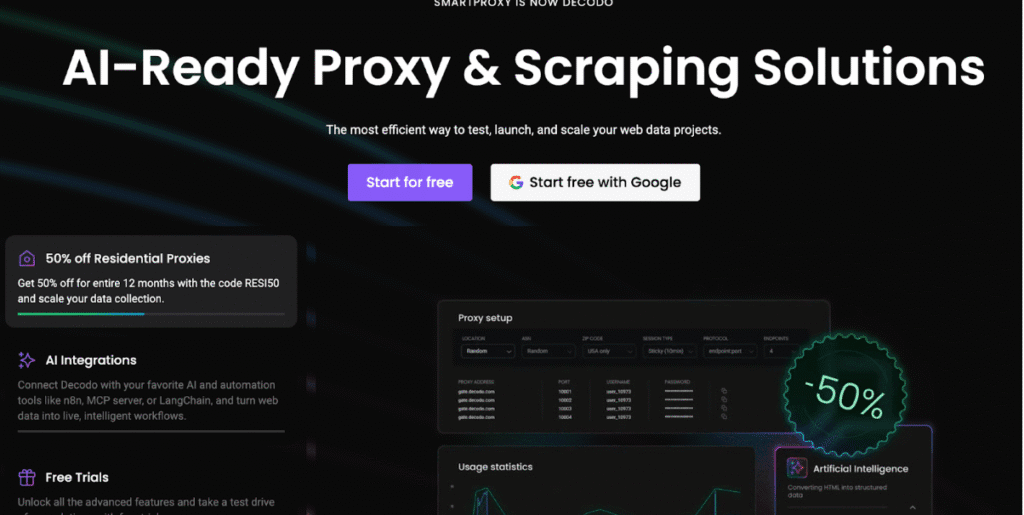
That’s one reason why many teams rely on platforms like Decodo, which maintain large, ethically sourced residential and mobile proxy networks across regions. This ensures requests look local, human-like, and genuinely aligned with how real users browse.
Geo-Rotation to Reduce Blocking
There’s another thing that really matters:
How your traffic is distributed across locations?
When traffic looks robotic or repetitive, that’s where throttling, rate limits, or outright blocking start to kick in.
Geo-rotation solves this problem by. Here’s what it means:
- Distribute Traffic Across Regions: you spread requests across multiple locations
- Avoid Traffic Clustering: no single node or IP absorbs all the activity
- Prevent Single-IP Fatigue: traffic looks natural, varied, and organic
- Smooth Request Patterns: just like real users logging in from different places at different times
Best Practices for Accurate Geo-Targeted Scraping
Here are a few simple best practices to keep your data clean, accurate, and sustainable:
- Match The Target Audience Region: always route traffic through the same country/city your users come from.
- Respect Rate Limits: natural browsing patterns reduce blocks and protect your infrastructure.
- Rotate Sessions Regularly: refresh identity over time so your traffic doesn’t look repetitive or automated.
- Use Realistic Browser Fingerprints: websites expect normal devices, browsers, and behavior.
- Avoid Scraping Logged-In Content: keep activity ethical, transparent, and access-appropriate.
- Cache Results Whenever Possible: if the content hasn’t changed, don’t re-fetch it.
- Validate Localized Values: check that currencies display correctly, language matches the region, and symbols & formats align with local standards.
Infrastructure Considerations
Here are a few important infrastructure factors:
- IP Trust Score: higher trust = fewer blocks
- ASN Reputation: residential or mobile networks generally score higher
- Session Persistence: stable, reusable sessions prevent friction and weird login resets
- Consistency Over Time: sudden spikes or erratic behavior can raise flags
- Speed vs. Stealth Balance: the best setups optimize for both stability and performance
- Retries That Don’t Look Suspicious: if something fails, retry gracefully from a different route
- Automatic Failover: if one node drops, traffic should simply reroute without downtime
In short, traffic quality determines scraping quality.
And instead of building and tuning all that proxy logic manually, many teams rely on Decodo’s GEO-aware scraping infrastructure, which automatically handles rotation, ASN diversity, retries, failover, and regional routing. This way, engineering teams can focus on the data instead of the back-end work.
Tooling & Workflow Example
| Workflow Type | No-Code Stack | Code-First Stack |
| How It Works | You configure scraping visually: select elements, schedule runs, and apply geo-targeting through built-in proxy settings | You write scripts to control browsers, handle sessions, and integrate geo-aware proxies programmatically |
| Typical Tools | Tools like Octoparse, Browse.ai, Apify UI, etc | Python, Playwright, Scrapy, Requests, REST APIs |
| Best For | Non-developers, marketers, analysts | Data teams, engineers, technical users |
| Pros | Easy onboarding, fast setup, minimal scripting required | Maximum control, automation depth, custom logic, scalability |
| Considerations | Less flexibility than code, may cost more at scale | Requires coding knowledge & maintenance |
How to Choose a GEO Proxy Provider
Here’s a clear, simple guide you can actually use:
- Region Coverage: Do they support all the countries you need?
- City-Level Targeting: Can you narrow down yo specific cities or metro areas when it matters?
- Mobile vs Residential Mix: Do they offer both?
- IP Freshness & Rotation: Are new IPs constantly introduced?
- Ethical Sourcing: Are IPs obtained with consent?
- Network Trust & Uptime: Do they maintain a strong availability (ideally 99.9%+)
- Rotation Control: Can you manage session duration, rotation timing, sticky sessions when required?
- Session Persistence: Can a single identity stay stable across flows like checkout, search, or browsing?
- Clear Logs & Observability: Are errors, retries, and routing paths easy to trace?
- Responsive Support: Can you talk to real humans when something happens, not just bots?
- Transparent Pricing Model: Is billing per IP, per request, per GB, and does it scale?
Legal, Ethical & Responsible Scraping
Here are the fundamentals every team should follow:
- Scrape OverPublicly Available Data: Avoid gated, private, or login-only content unless you have explicit permission.
- Respect Terms of Service Where Applicable: Understand platform guides, and operate transparently within your legal framework.
- Don’t Overload Servers: Keep request volumes reasonable. Sustainable crawling is good for everyone.
- Never Collect PII: Personal data is off-limits unless there is a lawful basis and informed consent.
- Follow Privacy & Data Protection Laws: Regulations like GDPR, CCPA, and regional equivalents matter, everywhere you operate.
- Build Compliance Into Your Systems: Logging, rate controls, permissions, and review processes help ensure responsible use, not just good intentions.
Who Benefits Most from Geo-Targeted Scraping?
Here are some of the groups that see the biggest wins:
- E-Commerce Teams: Track pricing, stock levels, and local offers across regions.
- Price Intelligence Platforms: Build fair, data-driven comparisons that reflect real-world markets.
- Travel Companies: Monitor regional pricing and availability across airlines, hotels, and OTAs.
- Fintech & Lending Platforms: Validate location-specific terms, fees, and eligibility rules.
- Marketing & Digital Agencies: Verify campaigns, creatives, and localized messaging at scale.
- SEO & Growth Teams: Check SERPs, ads, and ranking differences region-by-region.
- Market & Academic Researchers: Analyze behavior, content, and ecosystem shifts across geographies.
- Fraud Prevention Teams: Detect anomalies by comparing localized user experiences.
- Product & Growth Teams: Monitor competitors’ rollouts, pricing tests, and market variations.
- Marketplace Operators: Track supply, demand, and listing behavior across countries and cities.
The internet may feel global, but in reality, it behaves very locally. And what one user sees in New York can look completely different from what another sees in Singapore or Berlin.
Geo-targeted web scraping bridges that gap. It helps teams see the world through real users’ eyes, wherever they are. And when you pair geo-aware proxies with good scraping practices, you get data that’s not only more accurate, but also more sustainable long-term.
Because at the end of the day, geo-scale isn’t just about reaching more places. It’s about doing it with quality, diversity, and resilience, so every request feels natural, local, and human-like.
If your business touches multiple markets, building geo-targeted scraping into your toolkit isn’t just an upgrade; it’s a competitive advantage.
Check out our other expert guides here:
- Best Web Scraping Proxies in 2025
- Large-Scale Web Scraping – A Comprehensive Guide
- 10 Best AI Web Scraping Tools in 2025
FAQs
A well-designed scraping pipeline includes four key layers:
– Orchestration: Schedules jobs and manages concurrency
– Retry Queues: Automatically re-route failed requests
– Proxy + Geo-Routing: Routes traffic across trusted networks
– Observability: Monitors errors, success rate, latency, IP health
The most important scraping performance metrics include:
– Success Rate (1%): valid responses vs attempts
– Latency: response + processing time
– Coverage: % of target content captured
– Cost per GB/Request: real operating cost
– Block & CAPTCHA Rate: Early warning signal
– IP Burn Rate: Stability indicator
Use simple heuristics:
– Static Pages/Public Data: rotate frequently
– Logged Flows/Carts: keep sessions “sticky”
– High-Block Sites: rotate based on request volume
– User-like Behavior: match human session length
Generic proxy pools just provide IPs. Decodo adds intelligence on top of the, including:
– GEO routing
– ASN & carrier diversity
– Automatic rotation
– Retries & failover
– Traffic quality controls
– Ethically sourced residential + mobile networks
Disclosure – This post contains some sponsored links and some affiliate links, and we may earn a commission when you click on the links at no additional cost to you.