
Web scraping has become the backbone of data-driven decision-making across almost every industry. However, as your data needs grow, so do the challenges. That’s where smart, multi-region scraping infrastructure comes in. With the right setup, you can collect large-scale data smoothly, reliably, and without constant worrying, no matter where in the world your target websites are.
Small vs Large-Scale Scraping
| Aspect | Small-scale Scraping | Large-Scale Scraping |
| Data Volume | A few pages or small datasets | Millions of pages, continuous flows |
| Infrastructure | Single server/laptop | Distributed, multi-region architecture |
| Execution | Manual or basic job scheduler | Automated, event-driven pipelines |
| Speed | On-demand flexible timing | Near-real-time or high-frequency |
| Reliability | Breaks occasionally | Built for resilience & uptime |
| Compliance | Rarely formalized | Embedded governance & audability |
| Risk | Low impact when it falls | Business-critical when it fails |
| Focus | Getting data | Scaling data operations |
Why Architecture Matters
At a small scale, you can get away with quick fixes. At a large scale, architecture is the strategy.
Because when you’re scraping globally:
- Some regions block traffic differently
- Some websites throttle requests harder
- Some content loads dynamically
- Some data needs to be refreshed constantly
Without the right design, your system becomes fragile. With the right design, scraping turns a smooth, predictable data pipeline, instead of a daily battle with CAPTCHAs, bans, and rate limits. And that’s exactly where smart, multi-region infrastructure changes the game.
Why Multi-Region Scraping Matters
If all your traffic is routed through a single country or data center, you’re only seeing one part of the internet. When your decisions rely on that data, blind spots get expensive.
Multi-region scraping fixes that. It allows you to route requests through multiple geographic locations, so your data reflects how real users experience the web across the world.
Geo-Specific Results Aren’t the Same Everywhere
Websites personalize aggressively today. Prices, availability, content, and rankings, all of which can change based on:
- User country
- IP location
- Currency
- Or even language
So if you’re scraping from just one region, you’re missing context, and sometimes the reality.
Lower Latency = Higher Success Rates
The closer your scraping node is to the target server, the less suspicious the traffic looks. Shorter distance means:
- Faster response times
- Fewer timeouts
- Fewer CAPTCHAs
- Smoother extraction
That ultimately means more data with fewer headaches.
Reduced Blocking Risk
Sending all your requests from one region? That’s a very bot-like behavior. Multi-region routing spreads your footprint and your risk.
You look more like normal user traffic, your websites stay relevant, and your pipelines stay running.
Laws & Infrastructure Vary By Country
Data regulations aren’t universal. Regional routing allows you to:
- Respect location-based compliance
- Route through approved regions
- Store data responsibly
- Align with governance policies
Because scaling responsibly isn’t optional anymore, it’s foundational.
Better Training Data for AI & Analytics
When your data reflects real-world diversity, your insights suddenly get smarter and more human-aligned.
Multi-region scraping improves:
- Model fidelity
- Market sentiment accuracy
- Personalization strategies
- Demand forecasting
Great AI depends on great data, and great data depends on a global perspective.
Real-World Examples Where Multi-Region Wins
Retail Pricing Intelligence
Prices and offers change by country, city, and customer segment.
Multi-region scraping:
- Captures regional pricing
- Detects localized promotions
- Supports competitive benchmarking
Travel Aggregation & Comparison
Think about searching for flights, hotels, and rental platforms. Search results vary a lot by region.
Multi-region scraping helps platforms show fair, accurate comparisons, just as the real users would see them.
SEO Data & LLM Data Sourcing
Search rankings aren’t universal. A keyword that ranks #1 in India might not appear on page 1 in the US.
Mult-region collection makes:
- Keyword insights real
- SERPs location-true
- LLM training data more representative
Which means content strategy becomes smarter and more precise.
Sentiment & Market Intelligence
User opinions aren’t the same everywhere. Reviews, forums, social chatter, all of it shifts by culture and geography.
Multi-region scraping allows you to understand:
- Product prescription
- Brand voice resonance
- Regional buying behavior
Not just what people think, but where they think it.
The Core Building Blocks of Scalable Scraping
Here’s what that infrastructure really looks like:
Distributed Crawlers
They:
- Scale horizontally: Spin up more workers as load grows
- Share work through queues: No crawler gets overloaded
- Auto-retry failed requests: So temporary issues don’t break pipelines
A Smart Networking Layer
A smart networking layer includes:
- Proxy rotation so no single IP takes all the heat.
- ASN diversity so that traffic doesn’t all come from the same network provider, and it behaves like real user distribution.
- Geo-routing so that requests are routed through the right region for the data you need.
- Session persistence so that your scraper can maintain continuity when needed, as some websites expect users to stay during a session.
Note: Some providers, like Decodo, bundle ASN diversity, geo-routing, and session management into their proxy infrastructure so traffic naturally mirrors real-world user behavior across regions.
A Real Data Pipeline
A scalable system moves data through a clear flow:
ingestion —> cleaning —-> storage —-> analysis
That means:
- Malformed rows get fixed
- Duplicates get removed
- Structure becomes consistent
- Sensitive fields are handled properly
- Storage scales as your volumes grow
Monitoring & Observability
The difference between a fragile system and a reliable one is observability.
A real system tracks:
- Block rates: Are more requests getting denied than usual?
- Latency trends: Are responses slowing down in certain regions?
- Response quality: Are we actually getting valid content?
- Error patterns: Are failures random or systematic?
When all four layers work together, scraping evolves into a global data engine with:
- Distributed crawlers
- Smart networking
- Structured data pipelines
- Real-time observability
What Makes Scaling Hard
Here’s what teams actually run to when scraping at scale.
- Advanced Anti-Bot Systems: Even if you rotate IPs, if your traffic behaves nothing like a human, expect lots of blocks.
- CAPTCHAs Everywhere: Poorly handled, CAPTCHAs can break pipelines entirely.
- IP Reputation & Trust Scoring: If your traffic comes from one provider or region, then your reputation score drops fast.
- JavaScript Rendering: This means more compute, more latency, and more edge cases that build on complexity.
- Cost Control: At a small scale, costs feel invisible. At a large scale, they compound.
- Compliance & Responsibility: Scaling responsibly means building compliance into the system, not bolting it on later.
The Multi-Region Infrastructure Blueprint
Here’s the blueprint most high-performing teams converge toward.
Layer 1: Regional Orchestration
First, you deploy scraping jobs as close as possible to the target websites, across multiple global regions.
Why this matters:
- Latency drops
- Load looks natural
- Infrastructure adapts to regional differences
And because traffic originates from the right places, you also reduce fingerprint anomalies, like all traffic appearing from one country or ASN. That alone dramatically improves success rates.
Layer 2: Smart IP Rotation
A modern system doesn’t just cycle IPs randomly. It routes traffic with intent.
That means:
- Residential + mobile proxy pools for the toughest sites
- Geo-targeted routing to match user location
- Sticky sessions for login or cart flows where continuity matters
The goal is to make traffic behave normal, everyday user browsing, and not waves of identical-looking requests.
Note: Decodo helps automate this, routing traffic through residential and mobile networks while aligning IP geography and session behavior with real-user patterns.
Layer 3: Browser Simulation
Not every page needs a full browser, but some absolutely do.
So the smartest systems use:
- Headless browsers for JavaScript-heavy or protected pages
- Fast HTTP clients for simple endpoints
And they switch intelligently, instead of defaulting to the slowest, most expensive option every time.
Layer 4: Intelligent Backoff
Rather than hammering endpoints at fixed intervals, scraping platforms use:
- Adaptive rate limiting (slow down automatically when signals show pressure)
- Randomized timings (avoid robotic, detectable patterns)
Requests blend into normal traffic patterns, reducing suspicion and protecting IP reputation over time.
Layer 5: Storage Designed for Volume
At scale, storage architecture usually looks like this:
- S3/GCS/blob storage (for massive raw dataset dumps
- SQL databases (for structured, relational data with clear schemas)
- Columnar databases like BigQuery/ClickHouse (for lightning-fast analytics at scale)
This ensures:
- Ingestion is smooth
- Querying is fast
- Storage remains affordable
- The data stays usable long-term
Where Managed Scraping & Proxy Platforms Fit
Running a true multi-region scraping network sounds powerful. But building and maintaining it internally is rarely simple. That’s why many organizations now rely on managed scraping and proxy platforms, such as Decodo, to handle the heavy lifting at the network layer.
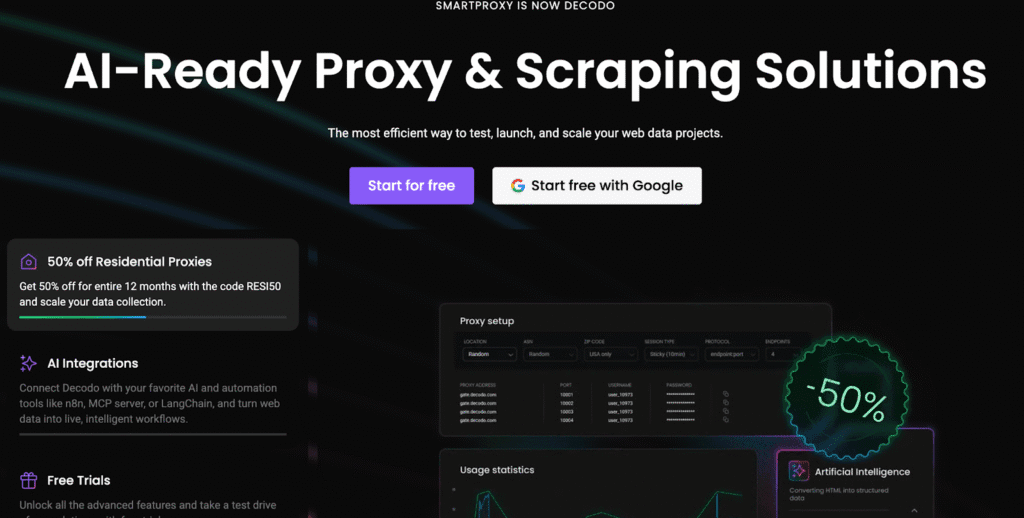
Platforms like these typically provide:
- Ethically-sourced residential and mobile IP pools.
- Automatic geo-targeting across regions.
- Built-in rotation, retries, and session management.
- Enterprise-grade uptime and reliability controls.
Instead of running and repairing proxy infrastructure day-to-day, teams can shift their focus back to what actually matters.
Best Practices for Scaling Without Burning Infrastructure
| Practise | Why It Matters | How to Apply It |
| Rotate IPs & ASNs | Prevents bans and reputation decay | Use diverse pools across regions & networks |
| Stagger Requests | Avoids detectable traffic bursts | Randomize timing; don’t scrape in rigid intervals |
| Cache When Possible | Reduces load & cost | Reuse data where freshness isn’t critical |
| Validate HTML Selectors | Prevents silent data corruption | Monitor for layout changes & fallback gracefully |
| Batch Process Data | Improves efficiency | Queue —> group —> process in controlled waves |
| Retry with Exponential Backoff | Handles transient failures safely | Retry slowly, don’t hammer endpoints |
| Log Everything | Enables real troubleshooting | Track latency, blocks, errors, response quality |
Tooling & Technology Stack
| Category | Tools Commonly Used | Typical Role in the Stack |
| Languages | Python, Node.js | Core scripting & orchestration for crawling, parsing & automation |
| Extraction Tools | Requests, Scrapy, Playwright, Puppeteer | Handle HTTP requests, crawling logic & browser simulation where needed |
| Pipelines | Airflow, Kafka, Spark, dbt | Job scheduling, streaming, large-scale processing & data transformation |
| Storage | Postgres, BigQuery, ClickHouse, S3/GCS | Structured storage, analytics warehouses & scalable object storage for raw data |
| Managed Platforms | Apify, Crawlbase | Outsourced crawling infrastructure & workflow automation |
Note: Decode already supports scraping workflows via APIs and proxy infrastructure, making it easier to run multi-region collection at scale.
Handling Big Data from Global Scraping
Here’s what a healthy post-scraping workflow usually includes:
1. Deduplication
The first step is to detect and remove duplicates to keep datasets clean, lean, and trustworthy. This prevents inflated metrics, noisy insights, and unnecessary storage usage.
2. Normalization (Make Data Consistent)
Global data rarely arrives in a neat, uniform manner. Normalization standardizes fields, so your analytics tools don’t have to guess.
3. Enrichment (Add Useful Context)
This includes:
- Converting prices into a base currency
- Tagging geography or market
- Categorizing product types
- Detecting language
This is where scraped data becomes business-grade intelligence, ready for dashboards and models.
4. Anonymization
This may include:
- Hashing identifiers
- Redacting sensitive fields
- Applying access controls
- Enforcing region-specific policies
Cloud platforms help here with encryption, IAM controls, and audit loggging, ensuring privacy and compliance stay intact.
5. Aggregation for Analytics
This allows you to answer questions like:
- How do prices trend by region?
- Which products gain momentum fastest?
- Where is sentiment shifting?
- What signals improve AI accuracy?
Columnar warehouses and cloud storage like BigQuery, ClickHouse, Redshift, Snowflake, S3, or GCS make it possible to run analytics across billions of rows quickly and cost-effectively.
Legal & Ethical Foundations
Here are the principles that matter most:
- Scrape only publicly available data
- Respect robots.txt where applicable
- Never collect Personally Identifiable Information (PII)
- Comply with local laws and regulations
- Limit server strain
Web scraping at scale isn’t about throwing more servers at the problem. It’s about building the right foundation. Multi-region infrastructure gives teams the reliability, coverage, and fidelity needed to turn global web data into real business intelligence, without constantly battling blocks, latency, or fragile pipelines. With the right architecture, scraping shifts from a risky side-project into a stable, long-term capability.
Check out our other expert guides here:
- Best Web Scraping Proxies in 2025
- Large-Scale Web Scraping – A Comprehensive Guide
- 10 Best AI Web Scraping Tools in 2025
FAQs
Use HTTP clients for static pages, APIs, or predictable HTML as they’re faster and cheaper. Switch to headless browsers only when content requires JavaScript rendering, login flows, or complex user behavior.
The core metrics are success rate, block rate, response completeness/quality, and cost per successful record.
Retry only when failures look temporary. Use exponential backoff with jitter to avoid creating traffic spikes, and cap retry attempts to control cost. If failures persist, reduce the request rate or rotate region/IP.
Costs generally rise with volume, rendering complexity, retry frequency, and IP quality. Good architecture keeps costs predictable by caching, batching, routing smartly, and minimizing retries.
Disclosure – This post contains some sponsored links and some affiliate links, and we may earn a commission when you click on the links at no additional cost to you.