
99.9% uptime sounds impressive, right? At first glance, it feels like your systems are running smoothly, your servers are always online, and everything is working exactly as it should.
But uptime isn’t just about servers being available. It’s about whether your data pipeline is actually doing its job.
In data-driven environments, especially when it comes to web scraping and large-scale data collection, infrastructure uptime and real performance aren’t always the same thing. Your servers might be up and running, but if your requests are getting blocked, your data is incomplete, or your pipelines are failing silently, can you really state that as uptime?
What really matters isn’t whether your infrastructure is online, but whether it’s delivering consistent, usable results. That’s why it’s important to rethink how we define uptime. Instead of focusing only on availability, the real metric should be success rate, which means how often your system actually retrieves the data it’s supposed to, without errors or interruptions.
In the end, real uptime isn’t about systems being live, but about systems working and consistently delivering the data you need.
What Does 99.9% Uptime Actually Mean in Web Scraping?
In simpler terms, 99.9% uptime in web scraping means:
- A high percentage of successful responses from target websites
- Minimal failed or blocked requests
- A consistent flow of usable data through your pipeline
Think of it like your servers could be running 24/7, but if a large chunk of your requests are getting denied, timing out, or returning incomplete data, your system isn’t truly “up” in a meaningful sense.
That’s why in scraping environments, uptime is better measured in successful requests rather than server availability.
Why Most Scraping Systems Fail to Achieve It
If achieving 99.9% uptime in web scraping were just about keeping servers online, most systems would get there easily. But as we’ve already seen, real uptime depends on something far more complex, like consistent, successful access to data.
This is where many scraping setups start to break down.
Today, the internet isn’t as open as it used to be. Websites today are equipped with increasingly efficient anti-bot systems designed to detect and block automated traffic. From CAPTCHAs and IP bans to request throttling and fingerprinting techniques, scraping at scale is no longer just a technical task; rather, it has become a constant game of adaptation.
And when these barriers kick in, the impact is immediate:
- Requests start failing or getting blocked
- Systems trigger retries, increasing load and delays
- Costs begin to rise as more resources are used to fetch the same data
This ties directly into what many call the “proxy paradox.” On the surface, adding more proxies or scaling infrastructure seems like the solution. But in reality, simply throwing more resources at the problem doesn’t guarantee better results. In fact, it can often make systems more inefficient and expensive without improving success rates.
Always remember that cheap or scaled infrastructure doesn’t guarantee uptime; successful access does.
If your system can’t reliably bypass restrictions and retrieve clean, complete data, no amount of uptime on paper will translate into real performance.
The Core Pillars of High Uptime Scraping Infrastructure
Let’s break down all the critical pillars one by one:
Smart Proxy Infrastructure
Sending repeated requests from the same IP address is one of the fastest ways to get blocked. That’s where smart proxy infrastructure comes in.
A strong setup typically includes:
- Rotating IPs to distribute requests and avoid detection
- A balanced mix of residential and datacenter proxies, depending on the use case
- Geo-distributed IPs to mimic real user behavior across different across different locations
This combination helps your requests appear more natural, reducing the chances of triggering anti-bot systems.
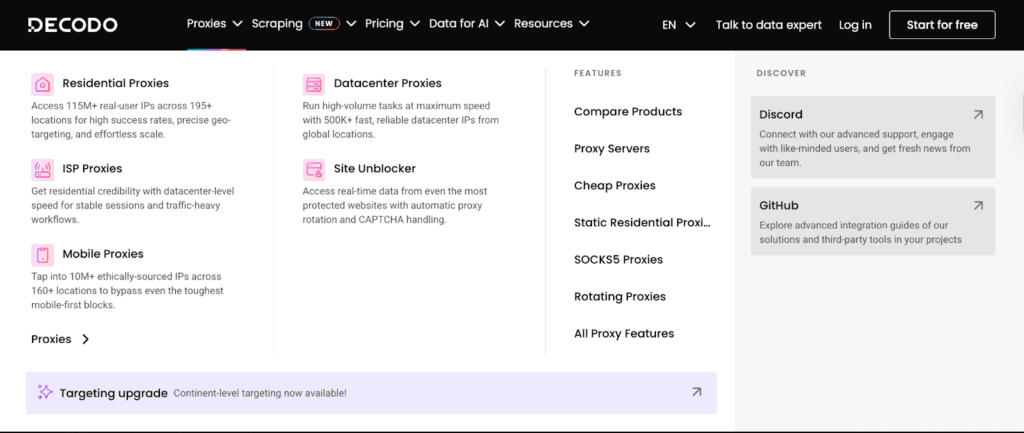
Platforms like Decodo play a crucial role here by providing a high success-rate proxy network designed specifically for large-scale data collection. Instead of manually managing IP pools and rotations, such platforms streamline the process, allowing your infrastructure to focus on consistent, successful data retrieval.
Request-Level Redundancy
When we talk about uptime in traditional infrastructure, redundancy usually means backup servers or failover systems kicking in when something goes down.
In web scraping, failures don’t just happen at the system level, but at the request level.
A single blocked request, a timeout, or a failed connection might seem small, but at scale, these failures add up quickly. That’s why high-uptime scraping systems rely on request-level redundancy rather than just infrastructure redundancy.
This means, instead of waiting for systems to fail, you build mechanisms that ensure each request has multiple chances to succeed.
This typically includes:
- Intelligent retries for failed requests, without overwhelming the target server
- Fallback proxy pools that switch IPs when one gets blocked or flagged
- Session rotation to avoid patterns that trigger anti-bot detection
Think of it as a safety net for every request your system makes.
So while SaaS platforms focus on redundancy at the server or system level, scraping infrastructure shifts that same concept down a level, ensuring redundancy is built into every interaction with the target website.
Horizontal Scaling Without Getting Blocked
Scaling is essential when you’re dealing with large volumes of data, but in web scraping, scaling isn’t just about sending more requests. It’s about sending them the right way.
Most modern scraping systems use techniques like asynchronous processing and concurrent requests to speed things up. Instead of waiting for one request to finish before starting another, multiple requests are handled in parallel, significantly improving efficiency.
On top of that, distributed scraping allows workloads to be spread across multiple machines or nodes, making it easier to handle large-scale operations without overloading a single system.
However, here’s where things get tricky. Scaling too aggressively can do more harm than good. A sudden spike in requests, even with proxies in place, can trigger anti-bot systems almost instantly. What looks like efficiency on your end can appear suspicious from the website’s perspective.
That’s why high-uptime systems focus on controlled scaling. This means:
- Gradually increasing request volume instead of sudden bursts
- Maintaining realistic request patterns that mimic human behavior
- Balancing speed with stealth to avoid detection
In scraping, it’s not just about how fast you can scale, but how sustainably you can scale without getting blocked.
Intelligent Rate Limiting & Adaptation
When it comes to maintaining high uptime, speed alone isn’t the answer. You also need to keep control in consideration.
That’s why smart scraping systems rely on intelligent rate limiting to stay under the radar while maintaining performance.
Instead of using fixed delays, modern setups use:
- Adaptive delays that adjust based on how the target website responds
- Per-domain tuning, where request behavior is customized for each website
Every website has its own tolerance level. Some allow higher request volumes, while others are far more sensitive. Treating them all the same is a recipe for blocks and failures.
By dynamically adjusting request frequency, your system can maintain a steady flow of successful responses without triggering defenses. In scraping, consistency beats speed every time.
Real-Time Monitoring & Feedback Loops
In traditional systems, uptime is tracked through server health and infrastructure monitoring. But in web scraping, that approach only tells part of the story.
Here, what matters is what’s actually happening at the request level.
High-uptime scraping systems rely on real-time monitoring and feedback loops to continuously optimize performance. This includes:
- Tracking success rates to understand how many requests are actually working
- Monitoring errors and failure patterns to quickly identify issues
- Measuring cost per successful request to ensure efficiency at scale
This constant feedback allows systems to adapt in real time by switching proxies, adjusting request rates, or rerouting traffic as needed.
In a way, this replaces traditional infrastructure monitoring. Instead of just asking, “Is the system up?”, you’re asking, “Is the system working efficiently and delivering results?”
Ultimately, visibility into performance is what allows you to maintain and improve your uptime over time.
The Hidden Layer: Proxy Quality = Uptime Multiplier
Proxy quality is one layer that often gets overlooked, even though it has a direct impact on everything else.
You could have the same infrastructure, the same scraping logic, and the same scaling strategy, but if your proxies are unreliable, your results will look completely different. Requests get blocked more often, sessions fail faster, and your system ends up spending more time retrying than actually collecting data.
On the flip side, better proxies change the equation entirely. With high-quality proxies:
- You see fewer blocks and CAPTCHAs
- Your success rate increases naturally, without excessive retries
- Your system becomes more efficient, using fewer resources to achieve the same output
Every failed request triggered additional work. More retries, more bandwidth, more cost. So when proxy quality improves, it doesn’t just fix one part of the pipeline; it reduces failure at the source.
This is where providers like Decodo make a significant difference. By offering high-quality, reliable proxy networks, they help reduce failure rates before they even enter your system, allowing your infrastructure to operate more smoothly and predictably.
The Uptime vs Cost Balance
Success isn’t measured by how many requests you send out, but by how much usable data you actually get back.
This is also where many systems experience what can be called scraping shock. A sudden spike in requests might seem like a good idea to speed things up, but it often triggers anti-bot defenses, causing success rates to drop and costs to rise sharply.
The key is to scale efficiently, not aggressively.
That means:
- Prioritizing consistent success rates over raw request volume
- Minimizing unnecessary retries by improving request quality
- Continuously optimizing for cost per success, not just output
Choosing a reliable proxy layer like Decodo often plays a key role here. By improving success rates and reducing failed requests, it helps bring down overall costs while keeping your system stable at scale.
Best Practice Checklist
If your goal is to achieve high uptime with scalable infrastructure, these are the practices that make a real difference:
- Use asynchronous scraping to handle multiple requests efficiently without slowing down your pipeline
- Rotate proxies intelligently to reduce detection and maintain consistent access
- Track success rate, not just bandwidth, to measure what actually matters
- Minimize unnecessary requests by optimizing your data extraction logic
- Avoid browser-based scraping unless absolutely needed, as it adds overhead and increases the risk of detection
By now, it’s clear that achieving 99.9% uptime in web scraping isn’t as straightforward as keeping your servers online. It’s not a feature you can simply switch on; it’s the result of multiple systems working together effectively.
From smart proxy infrastructure and request-level redundancy to controlled scaling and real-time monitoring, every layer plays a role in ensuring consistent performance. When these pieces are aligned, uptime becomes a natural outcome rather than a constant struggle.
Achieving 99.9% uptime isn’t about having a perfect infrastructure. It’s about building systems that adapt, recover, and succeed request after request.
Check out some of our other in-depth guides on web scraping and proxy services:
- How to Scrape Websites Without Getting Blocked
- Avoid IP Blocking in Web Scraping with IP Rotation
- Web Scraping at Scale with Smart, Multi-Region Infrastructure
FAQs
Start by adding retry logic for failed requests, along with fallback proxy pools and session rotation. Instead of relying on a single attempt, design your system so each request gets multiple chances to succeed using different IPs or sessions.
A good proxy rotation strategy distributes requests across a pool of IPs while avoiding patterns. This usually includes rotating IPs per request or session, mixing residential and datacenter proxies, and adjusting usage based on success rates.
There’s no fixed number, but excessive retries can increase costs and trigger detection. In most cases, 2-5 smart retries with different proxies or delays are more effective than repeatedly sending the same request.
Look for patterns in response time. Frequent CAPTCHAs, HTTP 403/429 status codes, or sudden drops in success rate usually indicate blocking, while random timeouts or connection errors may point to system-level failures.
Yes, in most cases. Higher-quality proxies reduce failure rates, which means fewer retries, lower bandwidth usage, and better overall efficiency, ultimately lowering your cost per successful request.
Disclosure – This post contains some sponsored links and some affiliate links, and we may earn a commission when you click on the links at no additional cost to you.