For years, marketers have relied on surveys, focus groups, and A/B tests to understand consumer behavior. While these tools can reveal what people say and do, they often provide only an indirect view of what is happening inside the mind.
Meta TRIBE v2 introduces something entirely different: an AI model designed to predict how the human brain responds to content before it ever reaches a real audience. Developed by Meta FAIR (Fundamental AI Research), the model was trained on more than 1,100 hours of functional MRI (fMRI) brain scans collected from human participants. By learning patterns in neural activity, TRIBE v2 can estimate how people may react to text, images, videos, and audio.
For marketers, this represents a fascinating shift. Instead of relying solely on post-exposure feedback, future campaigns could be evaluated for attention, engagement, and cognitive impact during the creative process itself. While the technology is still emerging, the potential implications for advertising, user experience design, and content optimization are significant.
Table of Contents
What is Meta TRIBE v2?
Meta TRIBE v2 is an artificial intelligence model designed to predict how the human brain responds to different types of content. The name TRIBE stands for TRImodal Brain Encoder, reflecting its ability to process multiple forms of media and connect them with patterns of neural activity.
TRIBE v2 is trained to understand the relationship between content and brain responses. It can process text, audio, images, and video, then estimate how different regions of the brain may react when exposed to that content.
Meta TRIBE v2 has been open-sourced by Meta FAIR, allowing researchers and developers to explore its capabilities and contribute to future advancements in brain-inspired AI.
How Meta TRIBE v2 Works
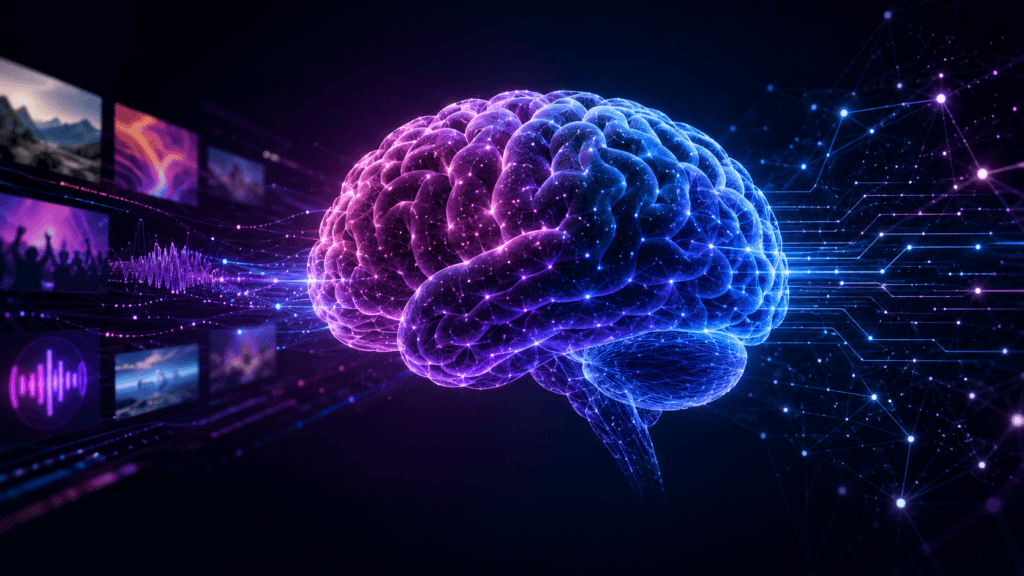
The model starts by taking different types of content input, like text, images, video, and audio.
Once the content is fed into the system, TRIBE v2 uses a combination of advanced AI models to process the information. These include technologies such as LLaMA for language understanding, V-JEPA for visual learning, and Wav2Vec for audio processing. Together, these models help TRIBE v2 understand what the content contains before estimating how the brain may respond to it.
The final set is a set of predicted brain activation maps. These maps represent the neural activity patterns that are likely to occur when a person views, reads, watches, or listens to the content being analyzed.
The easiest way to think about Meta TRIBE v2 is as a virtual neuroscience lab. The model estimates how people may process content based on patterns it learned from thousands of hours of brain imaging data.
Why Everyone Is Talking About the 70x Improvement
TRIBE v1 could predict activity across roughly 1,000 brain voxels. A voxel is essentially a tiny three-dimensional unit used to measure activity within the brain.
TRIBE v2 expands that capability dramatically, predicting activity across approximately 70,000 voxels. That represents a 70x increase in resolution, allowing researchers to capture far more detailed patterns of neural activity than before.
With the increased precision of TRIBE v2, researchers can potentially study more nuanced reactions to creative assets, including how different elements of content may influence perception, engagement, or cognitive processing.
What Makes TRIBE v2 Different From Traditional Neuromarketing?
| Traditional Neuromarketing | Meta TRIBE v2 |
| Requires human participants for testing | Uses a trained AI model to estimate responses |
| Relies on expensive fMRI studies and lab setups | Generates computational predictions |
| Limited by smaller participant samples | Enables more scalable testing and research |
| Research cycles can take weeks or months | Allows faster experimentation and iteration |
| High infrastructure and operational costs | Built around an open-source research model |
What Meta TRIBE v2 Could Mean for Marketers?
Here are some of the areas where technologies like TRIBE v2 could have the best impact.
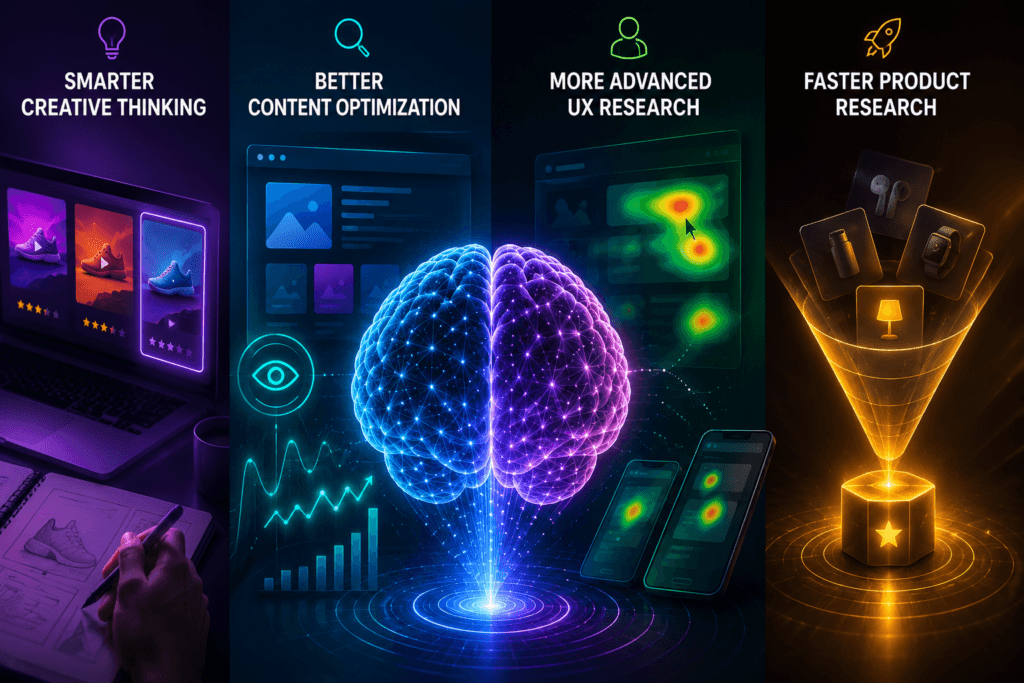
1. Smarter Creative Thinking
In the future, AI-powered brain models may introduce a different question:
Which ad creates stronger neural engagement?
This would help teams narrow down options faster and enter campaigns with stronger creative hypotheses.
2. Better Content Optimization
Future tools inspired by TRIBE v2 may help predict which versions of content are more likely to attract attention or maintain interest.
For content teams producing large volumes of assets, this could significantly reduce trial and error while improving creative decision-making.
3. More Advanced UX Research
Future neural prediction systems could help identify these friction points earlier in the design process.
As UX research evolves, teams may begin combining behavioral analytics with neural insights to develop a more complete understanding of user experience.
4. Faster Product Research
With tools inspired by TRIBE v2, researchers may be able to screen ideas earlier and identify promising directions before committing to large-scale testing.
Predictive neural models could help organizations move through the research process more efficiently and focus resources on the concepts most likely to resonate with audiences.
Will Meta TRIBE v2 Replace A/B Testing?
The short answer is no. Meta TRIBE v2 does not measure how real audiences behave in live environments.
A/B testing, on the other hand, serves a different purpose. It validates assumptions by observing actual user behavior. Clicks, conversions, engagement rates, purchases, and retention metrics all come from real people interacting with real content.
TRIBE v2 can help researchers form better hypotheses, while A/B testing helps determine whether those hypotheses hold up in the real world.
In the future, the most effective workflows will likely combine both approaches:
- Predictive neural modeling to estimate audience responses before launch
- Real-world behavioral testing to validate performance after launch
Rather than replacing A/B testing, technologies like Meta TRIBE v2 could become an additional layer in the decision-making process. Marketers may use AI-powered neural predictions to narrow down creative options and then rely on traditional testing to confirm what actually works with their audience.
Is Meta TRIBE v2 Available Today?
Yes, Meta TRIBE v2 is available today, but not in the way many marketers might expect.
At the moment, TRIBE v2 is primarily a research model, not a functional marketing platform. There is currently no dashboard where marketers can upload an ad, landing page, or video and instantly receive detailed neural engagement scores.
In other words, while the underlying technology exists, the commercial tools built on top of it are still largely in the future.
That means marketers should view Meta TRIBE v2 as an early glimpse into where audience research and content optimization may be headed, rather than a solution they can immediately integrate into their workflows.
For now, the technology remains largely within the realm of AI and neuroscience research rather than everyday marketing operations.
Explore more AI insights, tools, and emerging technologies in our collection of expert guides:
- AI-Native Marketing Teams: How to Restructure for 2026
- Best AI Avatar Generators in 2026
- Best AI Dictation Tools in 2026
FAQs
Meta TRIBE v2 is designed to estimate likely brain activity patterns, not provide perfect predictions. Its accuracy depends on the quality of the training data and the specific type of content being analyzed, making it more useful for research than definitive decision-making.
Potentially, yes. In the future, technologies inspired by TRIBE v2 could help marketers evaluate creative concepts, headlines, visuals, and video hooks before launch, enabling more informed campaign decisions.
Meta FAIR trained TRIBE v2 using more than 1,100 hours of fMRI brain scans collected from participants who were exposed to text, images, audio, and video content, allowing the model to learn relationships between media and neural activity.
While no commercial marketing products currently use TRIBE v2 directly, its underlying concepts could eventually influence future advertising, content optimization, and audience research tools as predictive brain modeling continues to advance.
Disclosure – This post contains some sponsored links and some affiliate links, and we may earn a commission when you click on the links, at no additional cost to you.