Artificial intelligence has moved well past the experimentation phase. In 2026, businesses across every sector are not asking whether to adopt AI but how fast they can do it and who can help them do it right. The agencies leading that charge are no longer generalist technology firms with an AI division. They are specialised teams with deep expertise in machine learning, agentic systems, generative AI, and data engineering, built specifically to translate AI capability into real business outcomes.
This guide covers the top AI agencies operating in the US right now, what each one does best, and how to choose the right partner for your needs.
Table of Contents
Why the US Leads in AI
The US has maintained its position at the front of the global AI race, and the gap has only widened in 2026. The country is home to the foundational model builders that power the entire ecosystem: OpenAI, Anthropic, Google DeepMind, and Meta AI. But the US advantage goes beyond the big names.
Top research universities, including MIT, Stanford, and Carnegie Mellon, continue to produce the talent and publish the foundational research that shapes how AI evolves. Government investment has accelerated as well, with federal and state-level initiatives funding AI infrastructure, safety research, and enterprise adoption programs. The World Bank and OECD have estimated that US investment in AI development exceeded $300 billion over the past decade, a figure that continues to grow.
What makes the current moment distinct is the shift from AI as a research priority to AI as an operational one. In 2026, the agencies leading the market are not just building models. They are building the systems, integrations, and workflows that make AI usable inside real organisations.
How AI Agencies Are Driving Business Success in 2026
The role of an AI agency has expanded significantly. Where agencies once focused primarily on consulting and custom model development, the best ones now operate across the full stack from strategy and data readiness through deployment, integration, training, and ongoing optimisation.
The clearest business impact in 2026 shows up in four areas.
Operational efficiency is the most immediate. Agencies are deploying agentic AI systems that handle complex, multi-step workflows without human intervention. Tasks that previously required dedicated staff time, including data processing, reporting, lead qualification, and customer communication, are now handled by AI agents that work continuously and improve over time.
The speed of innovation has compressed dramatically. AI agencies can take a validated concept to a working prototype in weeks rather than quarters. For businesses competing in fast-moving markets, this is a structural advantage.
Decision-making quality has improved as agencies bring predictive analytics and real-time data access into the tools executives and operators already use. Decisions that previously relied on instinct or lagging reports are now supported by live AI-generated insight.
Risk and compliance management has become an area where AI agencies add measurable value, particularly in regulated industries. Agencies with deep domain knowledge are building AI systems that flag compliance issues, detect fraud, and generate audit-ready documentation automatically.
Criteria to Choose the Best AI Agency
Expertise and experience. AI is evolving fast. The agencies that deliver results are the ones with verifiable project histories in your sector, not just general capability claims. Look for documented case studies, client reviews on independent platforms, and experience with businesses of comparable size and complexity.
Range of services. The best agencies cover the full lifecycle from initial strategy and data readiness assessment through implementation, integration, team training, and long-term maintenance. Agencies that only handle one part of the process often leave gaps that become expensive later.
Customisation and scalability. Off-the-shelf AI products rarely fit complex organisational needs. The right agency should build solutions tailored to your specific workflows and design them to scale as your business grows.
Integration capability. AI cannot deliver value in isolation. The agency you choose needs to integrate new systems with your existing infrastructure without causing disruption. This means experience with enterprise platforms, APIs, and legacy systems.
Industry knowledge. A generalist AI agency will understand the technology. An agency with deep sector experience will understand your problems. The difference matters most in regulated industries like healthcare, finance, and logistics.
Support and maintenance. Deployment is not the end of the project. AI systems require monitoring, updates, and refinement as your business evolves and as the underlying models improve. Ask specifically about what ongoing support looks like before you sign anything.
Measurable ROI. The right agency should be able to connect its work to specific business outcomes. If an agency cannot describe how they measure success, that is a signal worth taking seriously.
Client references. Ask for references from clients in similar industries. Independent reviews on platforms like Clutch and G2 are worth reading carefully.
Top AI Agencies in the US
1. Axe Automation, Boston, MA
Axe Automation combines AI and process automation to build intelligent workflows that reduce manual work and improve how teams operate. Their approach starts with thorough process mapping before any solution is built, which means improvements are grounded in how the business actually runs rather than how it looks from the outside.
Services: Automation consulting, workflow automation across systems, and custom AI solutions covering everything from CRM automation to predictive analytics.
What sets them apart: Axe Automation is industry agnostic and takes on everything from content creation automation to sales and customer service. They manage and improve solutions over time rather than handing off and walking away, which suits organisations that want a long-term partner rather than a one-time implementation.
Best for: Businesses that are not sure where to start with AI and want a team that will map the opportunity before recommending solutions.
2. NineTwoThree, Danvers, MA
NineTwoThree works with established brands and funded startups to take AI products from concept to scale. Their strength is end-to-end product development that covers strategy, design, engineering, and post-launch growth.
Services: Custom AI application development for mobile and web, automation strategy and consulting, and AI marketing services including acquisition optimisation and product launch support.
What sets them apart: Access to the founding team from the start of the engagement, and a structured Strategy Session process that takes three to five weeks and produces detailed product plans and innovation roadmaps before any build begins. They also offer engineer training on completed solutions, which reduces dependency on the agency after delivery.
Best for: Funded startups and mid-market brands that need a full product development partner with twelve-plus years of cross-industry experience.
3. Hatchworks, Atlanta, GA
Hatchworks is an AI and data engineering firm with a sharp focus on speed to value. They position themselves as end-to-end specialists, from data readiness and strategy through deployment and ongoing agentic automation.
Services: AI strategy and roadmapping, agentic AI automation, AI-powered software development, data engineering and analytics, and hands-on team training.
What sets them apart: Their Generative Driven Development methodology uses AI to accelerate software delivery and improve quality at the same time. Their proprietary accelerators, including an AI Solution Accelerator for low-risk prototyping and a RAG-based insight tool, help clients validate use cases and see results before committing to full deployment. They partner with Databricks for data engineering work.
Best for: Organisations that want a structured path from data readiness to deployed AI with a measurable and fast ROI.
4. Sigmoidal, New York City, NY
Sigmoidal is a consulting firm focused on generative AI strategy and implementation. Their team brings over eight years of applied AI experience and maintains partnerships with leading AI research institutions, which keeps their approach grounded in what actually works rather than what is currently being marketed.
Services: AI consulting covering supply chain intelligence, predictive analytics, and generative AI integration, plus custom AI software development for healthcare, manufacturing, and other sectors.
What sets them apart: A proof-of-concept approach that validates results before full adoption, a proprietary AI knowledge assistant called Aurora that deploys privately within a client’s environment, and a consistent focus on ethical AI with compliance, transparency, and data security built into every implementation.
Best for: Organisations in complex or regulated industries that need a rigorous, compliance-aware approach to generative AI adoption.
5. DevsData LLC, Brooklyn, NY
DevsData LLC specialises in AI, machine learning, and data science with a global delivery model across North America, Latin America, and Europe. Their team background spans FAANG companies, hedge funds, and research institutions.
Services: Technology consulting, including web scraping, CTO-on-demand, and code audits; data engineering; custom software development for complex backend and frontend systems; and IT recruitment for specialised technical roles.
What sets them apart: The depth of their team, with engineers from elite academic and industry backgrounds. Their battle-tested systems experience in finance, blockchain, and defence translates to reliability in high-stakes environments.
Best for: Businesses that need technical depth and global reach, particularly in fintech, blockchain, or other complex technical domains.
6. Markovate, San Francisco, CA
Markovate has delivered over 300 digital products and occupies a distinct position through its combination of generative AI expertise and Web3 capabilities. They focus on rapid, customised product development for small and mid-sized businesses.
Services: Generative AI consulting and development covering LLMs, ChatGPT integration, and prompt engineering; end-to-end AI software development; data engineering; UX and interface design; and blockchain development across multiple protocols.
What sets them apart: A technology stack that spans AI and Web3 in a single team, which is rare. Their specific AI products, including an agentic assistant, a blueprint classifier, a medical coding tool, and an AI voice agent platform, indicate practical depth rather than just consulting capability.
Best for: SMEs that want rapid AI product development and may also have blockchain or Web3 requirements.
7. Anodot, Ashburn, VA
Anodot focuses specifically on business monitoring. Rather than broad AI implementation, they use machine learning to surface anomalies, generate forecasts, and alert businesses to problems in real time before those problems become visible in standard reporting.
Services: AI-powered business monitoring, real-time anomaly detection, forecasting, and cost management for cloud and business operations.
What sets them apart: Anodot does one thing at a high level of sophistication. Their platform continuously analyses business metrics and flags deviations automatically, which suits organisations where late detection of a problem carries a high cost.
Best for: Data-driven businesses that need continuous monitoring and early warning systems rather than a general AI implementation partner.
8. SoluLab
SoluLab is a full-service AI and blockchain development agency with deep experience across enterprise sectors. They handle everything from initial consulting through to post-deployment support, with particular strength in custom AI product development and system integration.
Services: AI and ML development, generative AI solutions, chatbot and NLP development, blockchain and Web3 development, and enterprise software integration.
What sets them apart: Strong portfolio in both AI and blockchain, with enterprise integration experience across healthcare, finance, and supply chain sectors. Their team scales to match project complexity, from startup MVPs to large enterprise implementations.
Best for: Enterprises looking for a single partner that can handle both AI and blockchain requirements with a track record in regulated industries.
9. LeewayHertz
LeewayHertz has positioned itself at the forefront of enterprise AI with a particular focus on generative AI and agentic systems. They work with Fortune 500 companies and high-growth startups alike and have built a reputation for delivering production-ready AI systems rather than proof-of-concept work.
Services: Generative AI development, AI agent and multi-agent system development, LLM fine-tuning and deployment, AI consulting, and data engineering.
What sets them apart: Their ZBrain platform for enterprise AI development accelerates custom AI product builds significantly. Their published work in agentic AI, including multi-agent architectures and autonomous workflow systems, reflects genuine depth in one of the fastest-moving areas of applied AI in 2026.
Best for: Enterprises and well-funded startups that need production-grade generative AI and agentic systems with enterprise-level security and scalability.
10. Dash Technologies
Dash Technologies is a software and AI development company with a strong focus on modernising legacy systems and integrating AI into existing enterprise environments. Their work tends to be deep, long-term engagements rather than quick builds.
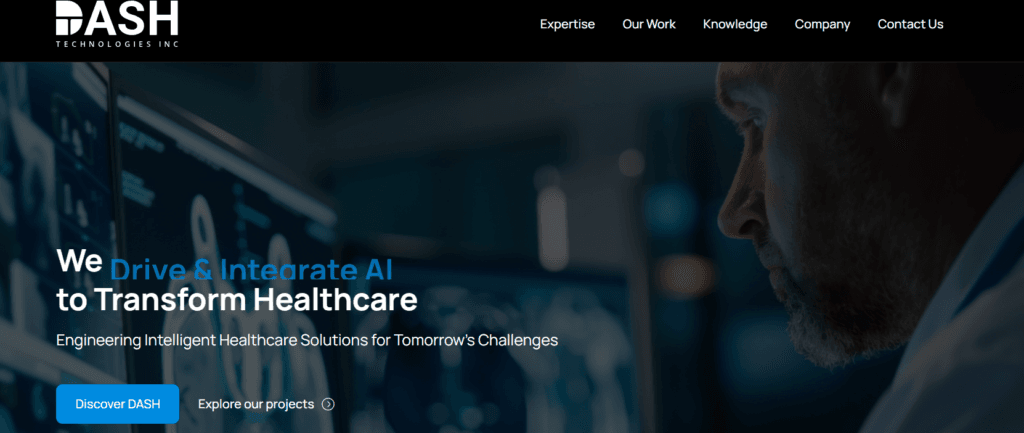
Services: AI and ML integration, enterprise software modernisation, cloud migration, data engineering, and custom application development.
What sets them apart: Their focus on making AI work inside existing systems rather than replacing them is particularly valuable for large organisations with significant legacy infrastructure. They bring change management experience alongside technical capability, which matters when AI adoption involves organisational as well as technical change.
Best for: Large enterprises with legacy infrastructure that need a measured, integration-first approach to AI adoption.
Final Thoughts
The AI agency market in 2026 is mature enough that the differences between firms are meaningful. Some specialise in speed and product development for startups. Others are built for the complexity and compliance requirements of large enterprises. Some focus on a single high-value capability like monitoring or agentic automation. Others offer full-spectrum services from data readiness through deployment and training.
The right starting point is understanding where your most pressing AI opportunity or gap actually is, then matching that to an agency with a verifiable track record in that specific area. Client reviews, published case studies, and direct conversations with the founding team will tell you more than any website.
AI adoption at scale requires a partner that understands your business as well as the technology. The agencies on this list have demonstrated both.
Related Blogs
Top AI Marketing Agencies in the UK
FAQs
An AI agency helps businesses design, build, and deploy artificial intelligence solutions. Depending on the agency, this can include strategy and consulting, custom model development, workflow automation, data engineering, system integration, team training, and ongoing support. The best agencies cover the full lifecycle rather than just one part of it.
A software development agency builds applications and systems. An AI agency specializes in solutions that learn from data, automate complex decisions, and improve over time. Many AI agencies also offer software development, but their core expertise is in machine learning, generative AI, and intelligent automation rather than general engineering.
Costs vary significantly depending on the scope of work, the complexity of the solution, and the agency’s location and team size. Strategy engagements and audits can start in the low thousands. Full custom AI product builds for enterprise clients can run into the hundreds of thousands. Most agencies offer a discovery call or initial assessment before quoting.
A proof of concept or initial prototype can be delivered in two to six weeks with the right agency. A full production deployment with integrations, testing, and team training typically takes three to six months. Ongoing maintenance and optimization continue after that.
Not necessarily. Many agencies offer data readiness assessments as a first step. That said, the quality and availability of your data will directly affect what is possible and how quickly results can be delivered. Agencies like Hatchworks and DevsData have specific offerings designed to get data infrastructure in shape before model development begins.
No. Several agencies on this list, including NineTwoThree and Markovate, specialize specifically in working with funded startups and small to mid-sized businesses. The cost of AI development has come down significantly and many solutions that were previously only accessible to large organizations are now practical for smaller ones.
How do I know if an AI agency is delivering results?
Set clear success metrics before the project begins. Good agencies will propose KPIs tied to business outcomes rather than technical milestones alone. Ask for case studies from similar clients, check independent review platforms like Clutch and G2, and request references you can speak to directly.
Agentic AI refers to AI systems that can plan, make decisions, and take actions autonomously across multi-step workflows without requiring human input at each stage. In 2026 it represents one of the most significant shifts in applied AI, enabling businesses to automate complex processes that previously required skilled human judgment. Several agencies on this list, including Hatchworks and LeewayHertz, have deep specialization in this area.