
Proxy servers are a basic but important tool to protect your online safety. They work by hiding your real location and filtering out harmful traffic before it reaches your device.
In 2025, the best proxy servers do this quietly in the background. They keep your personal information private, stop attacks before they happen, and help you use the internet without extra slowdowns. If you want to surf safely and protect your data, learning about the top proxy servers can be really helpful.
In this blog, we will look at the best options available so you can choose what fits your security needs.
What is a Proxy Server?
A proxy server is a middleman between your device and the internet. When you connect to a website or online services, your request goes through the proxy first. The proxy then forwards your request to the destination and sends the response back to you. This process hides your real IP address and can protect your identity. Proxy servers also filter harmful content and improve security for users or networks.
Types of Proxies in Cybersecurity
- Forward Proxy: Acts as an intermediary for users accessing the internet. It hides user IP addresses and filters outgoing requests to improve privacy and security.
- Reverse Proxy: Works on behalf of servers, handling incoming traffic, distributing load, and protecting servers from direct attacks.
- Transparent Proxy: Often used in schools or companies, it intercepts traffic without hiding itself. It helps with content filtering but offers less privacy.
Role of Proxy Servers in Cybersecurity
- Hiding Real IP Addresses: Proxy servers mask the user’s actual IP, making it hard for attackers to trace or target them online.
- Filtering Out Malicious Content: They block access to harmful websites and filter suspicious traffic before it reaches the device.
- Controlling Network Access & Usage: Businesses use proxies to monitor and restrict employee internet activity for safety and compliance.
- Preventing Overload & Direct Server Attacks: Reverse proxies distribute incoming traffic to avoid server crashes and block direct attacks.
Table of Contents
| 1. Zscaler |
| 2. CloudFlare |
| 3. Palo Alto Networks |
| 4. Cisco Umbrella |
| 5. Netskope |
| 6. Forcepoint One |
| 7. Imperva |
| 8. Akamai |
Best Proxy Servers for Cyber Security
1. Zscaler
Zscaler is a cloud-based security platform that checks all internet traffic, including encrypted data. It works by routing user traffic through a vast cloud network to stop modern cyber threats, such as ransomware, quickly. Without relying on traditional hardware, it reduces delays, especially for remote and hybrid workforces. The platform combines multiple security tools in one place for easy management and lower costs.

Key Features
- Scanning Encrypted Traffic: Zscaler inspects SSL and TLS-encrypted traffic to detect hidden threats that otherwise go unnoticed.
- Using AI for Threat Detection: It uses artificial intelligence to quickly identify ransomware, zero-day exploits, and other advanced malware.
- Direct Cloud Connectivity: Traffic is sent directly to the nearest cloud data center to improve speed and reduce latency.
- Combining Multiple Security Services: It integrates web filtering, data loss prevention, zero-trust access, and more in a single platform.
- Protecting Devices without Agents: Even devices without special software installed are protected against data leaks and malware.
Pros
- Strong protection, including encrypted data.
- Good for remote workers.
- Lowers the need for hardware appliances.
Cons
- Setup can be complex.
- Enterprise pricing is not ideal for smaller organizations.
2. Cloudflare
Cloudflare provides protection for websites and online resources using a global network that combines a reverse proxy with a content delivery network. It speeds up content delivery worldwide while defending against large attacks like DDoS and filtering malicious traffic early. DNS filtering and web application firewall protect against harmful domains and exploits.

Key Features
- Global Network for Fast Content: Cloudflare uses many data centers worldwide to deliver content quickly.
- DDoS Attack Protection: It absorbs large-scale attacks to keep sites online.
- DNS-Level Blocking: Harmful domains are blocked at the domain name lookup stage.
- Web Application Firewall: Rules protect against common web-based attacks.
- Bot Detection & Control: Malicious bots are blocked while allowing real visitors.
Pros
- It helps improve website speed.
- The platform is easy to set up.
- Strong protection against web attacks.
Cons
- Cached content updates can be delayed.
- The free plan has limited features.
3. Palo Alto Networks
Palo Alto integrates proxy functions within its next-generation firewalls. This allows detailed control over applications and user activity, with online traffic inspection and unified policy management, helping enforce security rules consistently.

Key Features
- Application & User-Based Rules: Allows detailed policies based on which apps or users generate traffic.
- Real-Time Traffic Inspection: Analyzes network traffic efficiently with minimal delay.
- Multiple Authentication Options: Supports different secure login methods.
- Centralized Policy Management: Manages firewall, proxy, and threat policies from one interface.
Pros
- Fine control over users and apps.
- Suitable for enterprise scale.
- Combines many security tools.
Cons
- The setup might be complex for new users.
- Optimized mainly for certain traffic types.
4. Cisco Umbrella
Cisco Umbrella is a cloud-based secure internet gateway that mixes DNS filtering with a proxy to block malicious sites early. It offers deep web traffic inspection, cloud-delivered firewall features, and remote browser isolation to protect users everywhere.

Key Features
- DNS-Layer Threat Blocking: Blocks requests to harmful websites at the DNS level.
- Secure Web Gateway: Inspects web traffic deeply to catch threats.
- Cloud Firewall Features: Extends firewall protection without needing hardware.
- Remote Browser Isolation: Runs web sessions remotely to prevent local exposure.
Pros
- Easy to add to existing networks.
- Fast detection of threats.
- Great for remote and mobile workers.
Cons
- Advanced features require higher plans.
- Occasionally blocks safe sites by mistake.
5. Netskope
Netskope is a cloud-native security platform that protects data and stops threats across cloud services, websites, and private apps. It uses a mix of cloud access security broker technology and proxy functions to give deep visibility and control over user activities. It applies zero-trust security policies based on user context, device, location, and app type. Its AI-powered engine detects malware and risky behavior in real time while simplifying management through a single platform.

Key Features
- Inspecting Traffic Across Web & Cloud: Netskope watches all user activities on web and cloud apps to stop risks and enforce compliance automatically.
- Applying Adaptive Zero-Trust Policies: It adjusts security rules in real-time depending on who is accessing what, from where, and on which devices.
- Blocking Threats Early with AI: Advanced AI scans all content and connections to block malware, ransomware, and leaks before harm occurs.
- Monitoring Shadow IT Usage: Netskope detects and controls unsanctioned apps that users may employ, closing security gaps.
- Unified Platform for Easy Management: Combines secure web gateway, CASB, data loss prevention, and zero-trust network access in one console.
Pros
- Deep cloud and web security with real-time threat prevention.
- Granular control based on user, devices, and app context.
- Simplified management on a single platform.
Cons
- Setup and tuning require expertise.
- It may be costly for small organizations.
6. Forcepoint One
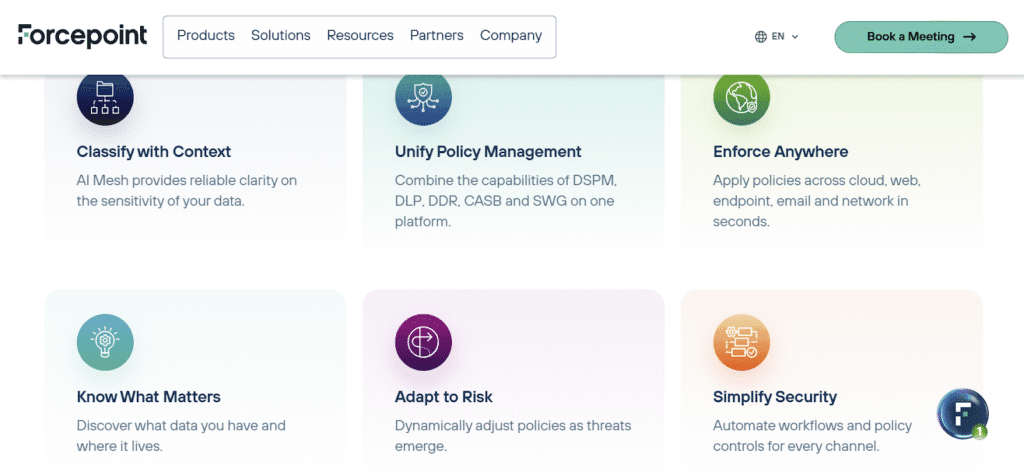
Forcepoint One offers a cloud security platform focused on zero-trust principles. It secures user access to apps and data by verifying every request and continuously monitoring for harmful activity. The Platform uses machine learning to identify risky behavior and encrypts data while in transit and at rest. Protection extends across cloud, web, and private networks with scalable global access.
Key Features
- Enforcing Zero-Trust Access: Only approved users and devices get the right level of access to resources.
- Using Machine Learning for Threat Detection: Constant analysis of user actions and traffic uncovers suspicious patterns quickly.
- Protecting Data With Encryption and DLP: Encrypts sensitive information and prevents data loss through policy enforcement.
- Providing Cloud-Delivered Security: Offers fast, distributed protection accessible from any location or device.
Pros
- Strong zero-trust and adaptive access control.
- Efficient detection of sophisticated attacks.
- Scalable for any business size.
Cons
- It can be complex to deploy and manage.
- Key features might require additional fees.
7. Imperva
Imperva provides comprehensive web application security by combining a proxy with a web application firewall and DDoS protection. It safeguards websites from common web attacks and controls access to sensitive data. Using global threat intelligence, it offers updated defenses and real-time monitoring to prevent downtime and data breaches.
Key Features
- Protecting Applications From Attacks: Blocks injection, cross-site scripting, and other vulnerabilities targeting web apps.
- Using Live Threat Intelligence: Constantly updates protections based on emerging threats seen worldwide.
- Stopping Denial of Service Attacks: Prevents website crashes by traffic floods known as DDoS attacks.
- Controlling Data Access: Monitors who can reach sensitive information and logs their actions
Pros
- Reliable firewall and DDoS defense.
- Insightful threat intelligence and monitoring.
Cons
- It can be pricey for smaller teams.
- Setup may require specialized expertise.
8. Akamai
Akamai operates one of the largest content delivery networks, combined with a secure web gateway proxy. It improves website speed globally while blocking bad traffic near the user. Its edge security model includes bot management, web application firewall, and API protection to secure online services.

Key Features
- Speeding Up Content Delivery Globally: Uses numerous servers around the world to reduce delay and improve loading times.
- Blocking Threats Close to Users: Filters malicious requests and content early at the network edge.
- Defending Against Large-Scale Attacks: Absorbs and mitigates DDoS attacks by spreading traffic across its network.
Pros
- Very fast delivery on a global scale
- Strong early-stage threat defense
- Broad security features in a single offering
Cons
- The price may be high for small organizations.
- Setup and management can be complicated.
Conclusion
In conclusion, proxy servers play a vital role in enhancing cybersecurity by protecting data, blocking threats, and securing user access across networks.
Choosing the right solution depends on your specific needs, such as ease of use, level of control, and integration with existing security layers.
Effective proxy solutions provide strong encryption, deep traffic inspection, adaptive policies, and protection against malware and attacks. Combining proxies with other security measures like firewalls and zero-trust access strengthens defenses against today’s complex cyber risks.
Investing in a capable proxy server setup is essential to ensure safe and reliable internet use in 2025 and beyond.
Check out our other blogs for more AI tools and insights:
- Best Proxy Manager Platforms in 2025
- Forward Proxy vs Reverse Proxy: What’s the Difference?
- Top Proxy Service Providers in 2025
FAQs
While proxies mask IPs and can filter traffic, they often lack the full encryption that VPNs provide, which encrypts all data leaving the device for stronger privacy protection.
Yes, compromised proxies can be exploited for man-in-the-middle attacks or data interception. Using encrypted proxy protocols and selecting trusted providers reduces this risk.
Logging varies across providers; excessive or insecure logging can expose sensitive information. Organizations should prefer proxies with clear, minimal logging and strong access controls.
Proxies can enforce zero-trust by controlling access, inspecting traffic, and authenticating requests, but must work alongside other security measures like endpoint protection and monitoring.