Programmatic SEO allows teams to create large numbers of targeted pages using structured datasets and reusable templates. But creating hundreds or thousands of pages is only part of the process. Those pages still need useful, differentiated information and need to be managed effectively after publication.
This is where programmatic SEO tools can help. Some focus on content generation, while others handle data, templates, CMS integration, keyword research, optimisation, or performance monitoring. The right tool depends on which parts of the programmatic SEO workflow you need to manage.
Here are 12 programmatic SEO tools to consider, covering different stages of the pSEO workflow.
Quick Answer: Programmatic SEO Tools
| If you need… | Consider |
| Keyword research and SEO patterns | Ahrefs or Semrush |
| Low-competition long-tail keywords | Keyword Chef |
| A structured content dataset | Airtable |
| A simple, accessible dataset | Google Sheets |
| A database for complex or dynamic data | Supabase |
| No-code programmatic page creation | SEOmatic |
| AI-generated content at scale | Byword |
| CMS-based page publishing | Webflow |
| Programmatic pages in WordPress | WordPress + Page Generator Pro |
| Technical QA across large page sets | Screaming Frog |
| Indexing and post-publication performance data | Google Search Console |
How We Evaluated These Programmatic SEO Tools
| Evaluation factor | What we looked at |
| Programmatic page generation | Whether the tool can generate pages from datasets, templates, variables, or structured inputs. |
| Data flexibility | Whether it can work with spreadsheets and databases, APIs, feeds, or custom datasets. |
| Template control | How much control teams have over page structure, content fields, layouts, and reusable templates. |
| AI capabilities | Whether AI supports content generation, enrichment, or other parts of the pSEO workflow. |
| CMS integrations | Compatibility with platforms such as WordPress, Webflow, Shopify, or other publishing systems. |
| Quality Control | Whether teams can review, approve, filter, edit, or reject pages before they are published. |
| Technical SEO | Support for elements such as URLs, metadata, schema, internal linking, sitemaps, and indexing controls. |
| Monitoring | Whether the tool provides visibility into indexing, traffic, rankings, or other post-publication performance data. |
| Ease of use | The level of technical knowledge required, from no-code workflows to developer-level implementations. |
What is Programmatic SEO?
Programmatic SEO is an approach to creating large numbers of targeted web pages using structured data, reusable templates, and a defined publishing process. Instead of creating every page manually, teams use a common system to generate pages around specific search queries or use cases.
How Programmatic SEO Works
A typical programmatic SEO workflow looks like this:
Data → Template → Page generation → Quality control → Publishing → Measurement
The process starts with a structured dataset containing information that can be used across multiple pages. A template then defines how that information is presented, allowing the system to generate pages at scale. Before publishing, those pages should be reviewed for accuracy, usefulness, duplication, and technical issues. Once published, their performance can be monitored, and the templates or underlying data can be updated where needed.
Programmatic SEO works best when a website has repeatable search patterns, structured data, and enough meaningful variation to create genuinely useful pages. It is particularly suitable for use cases such as location pages, product combinations, directories, comparison pages, and other page types where the underlying information changes systematically.
Comparison Table of 12 Best Programmatic SEO Tools
| Tool | Best for | Role in the pSEO workflow |
| Ahrefs | Keyword research and pattern discovery | Research → Validation |
| Semrush | Keyword clustering and search-intent analysis | Research → Validation |
| Keyword Chef | Finding low-competiton long-tail opportunities | Research → Validation |
| Airtable | Structured datasets and workflow management | Data → Workflow |
| Google Sheets | Smaller datasets and straightforward pSEO projects | Data → Workflow |
| Supabase | Larger or dynamic datasets | Data → Infrastructure |
| SEOmatic | No-code programmatic page creation | Template → Page Generation |
| Byword | AI-assisted content generation at scale | Content → Page Generation |
| Webflow | CMS-based publishing and structured page collections | Publishing |
| WordPress + Page Generator Pro | Scalable page generation within WordPress | Page Generation → Publishing |
| Screaming Frog | Technical QA and large-scale site checks | Quality Control → QA |
| Google Search Console | Indexing and post-publication performance monitoring | Indexing → Measurement |
12 Best Programmatic SEO Tools
| Table of Contents |
| Keyword Research & Pattern Validation |
| 1. Ahrefs |
| 2. Semrush |
| 3. Keyword Chef |
| Dataset Building & Management |
| 4. Airtable |
| 5. Google Sheets |
| 6. Supabase |
| Template & Page Generation |
| 7. SEOmatic |
| 8. Byword |
| CMS & Publishing |
| 9. Webflow |
| 10. WordPress + Page Generator Pro |
| QA, Indexing & Monitoring |
| 11. Screaming Frog |
| 12. Google Search Console |
Keyword Research & Pattern Validation
1. Ahrefs
Ahrefs is an SEO platform that can help with keyword research, competitor analysis, and identifying recurring search patterns. For programmatic SEO, its main use is finding the keyword structures and modifiers that can potentially be turned into scalable page templates.

Key features:
- It provides keyword ideas and long-tail variations for different search intents.
- It lets you analyse competitors’ keywords and top-performing pages.
- It provides search volume and keyword difficulty data to assess opportunities.
- It includes SERP analysis for understanding the pages ranking for a query.
- It helps identify recurring keyword patterns and potential clusters.
Pros:
- It provides extensive keyword and competitor data.
- It is useful for identifying recurring search patterns for scalable pages.
- It offers strong SERP and competitor analysis capabilities.
Cons:
- Its pricing may be relatively high for smaller teams.
- It is not specifically designed as a programmatic SEO platform.
Why use Ahrefs for programmatic SEO?
Ahrefs can help validate whether a potential programmatic SEO pattern has meaningful search demand before building pages around it. For example, a travel site could use competitor and keyword data to identify recurring combinations of locations, services, or other modifiers, then use those patterns to define the variables in a page template.
The tool is particularly useful at the research and validation stage of the SEO workflow. It doesn’t generate or publish the pages itself, but it can help determine which page patterns are worth building in the first place.
2. Semrush
Semrush is an all-in-one SEO and digital marketing platform with tools for keyword research, competitor analysis, clustering, and search-intent analysis. For programmatic SEO, it can help identify recurring keyword patterns and group related queries before turning them into scalable page structures.

Key features:
- It provides keyword ideas, related terms, and long-tail variations.
- It groups keywords based on semantic similarity and search intent.
- It provides search volume, keyword difficulty, and SERP data for evaluating opportunities.
- It lets you analyse competitors’ keyword rankings and page performance.
- It supports keyword research across different locations and markets.
Pros:
- It combines keyword research with competitor and SERP analysis.
- Its clustering capabilities can help organize large keyword sets.
- It provides useful search-intent and keyword-difficulty data for validating page opportunities.
Cons:
- Its extensive feature set can be more than smaller pSEO projects need.
- Some advanced features require higher-tier plans.
- It is not specifically built for programmatic SEO page generation.
Why use Semrush for programmatic SEO?
Semrush is useful for the research and validation stage of programmatic SEO. Its main keyword research and clustering capabilities can help identify recurring search patterns, group related queries, and assess whether there is enough demand to justify creating a scalable page template.
For example, an ecommerce site could use Semrush to identify combinations of product types, features, and locations that people search for, then use those patterns to define the variables for its programmatic pages. It can also help compare competitors’ keyword coverage and identify gaps worth exploring.
3. Keyword Chef
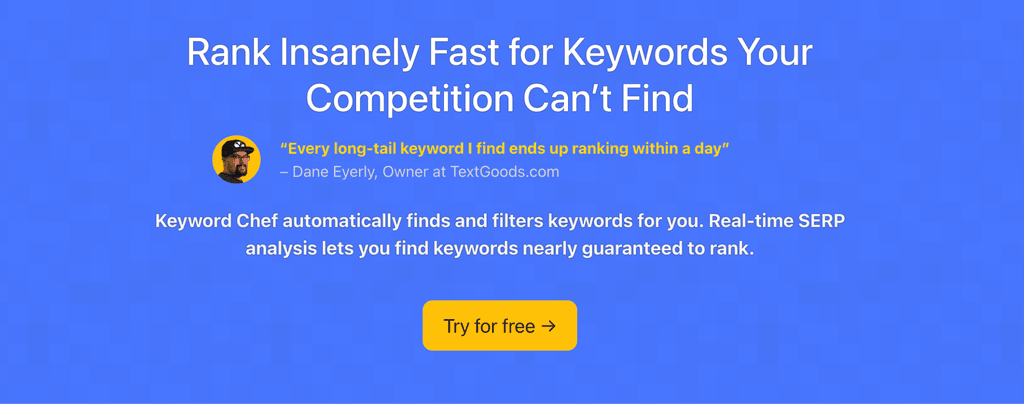
Keyword Chef is a keyword research tool focused on finding low-competition search opportunities, particularly long-tail keywords. For programmatic SEO, it can help identify specific search patterns that may be suitable for creating targeted pages at scale.
Key features:
- It generates long-tail keyword ideas based on seed terms.
- It focuses on identifying lower-competition search opportunities.
- It provides keyword difficulty and search-volume data for evaluating terms.
- It helps uncover question-based and niche search queries.
- It can help identify patterns across related long-tail keywords.
Pros:
- It is focused on finding lower-competition keyword opportunities.
- It can be useful for discovering specific long-tail search patterns.
- Its simpler focus can make keyword research easier for smaller projects.
Cons:
- It has a narrower feature set than broader SEO platforms.
- It may provide less competitor and SERP analysis than tools such as Ahrefs or Semrush.
- It is primarily a keyword research tool rather than a complete programmatic SEO platform.
Why use Keyword Chef for programmatic SEO?
Keyword Chef can be useful during the keyword discovery and pattern-validation stage of a programmatic SEO workflow. Its focus on long-tail and lower-competition queries can help identify groups of specific searches that may be difficult to uncover through broader keyword research alone.
For example, a website could use Keyword Chef to find recurring variations around a particular product, service, or location, then evaluate whether those variations contain enough useful and distinct intent to justify separate programmatic pages.
Dataset Building & Management
4. Airtable
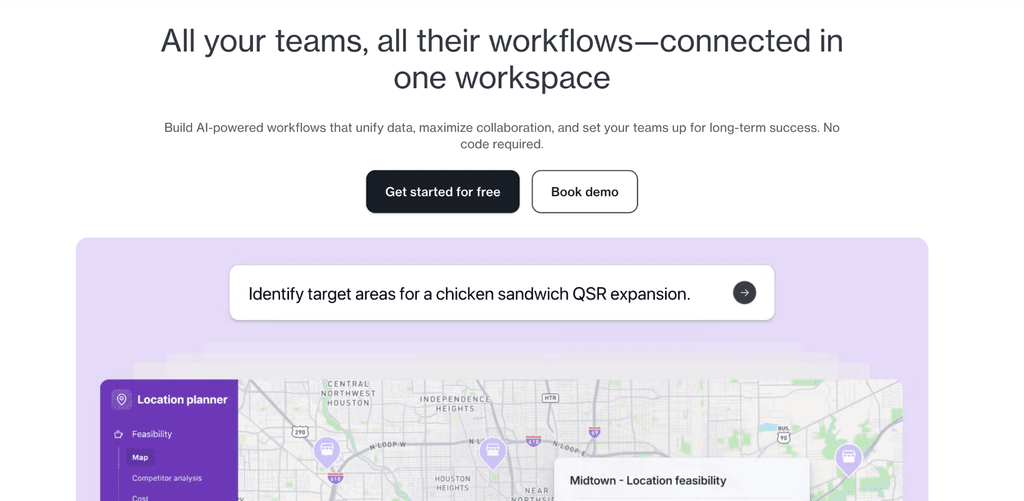
Airtable is a database and workflow platform that can help teams organize structured information used in programmatic SEO. Its relational structure makes it useful for managing datasets with multiple fields, linked records, and content variables that feed into page templates.
Key features:
- It lets teams organize large datasets into structured tables and linked records.
- It supports different field types for storing text, URLs, images, categories, and other page variables.
- It allows related datasets to be connected through linked records.
- It provides views and filters for reviewing and managing specific groups of records.
- It supports automations that can help move data through different stages of a workflow.
Pros:
- It provides a structured way to manage the data behind programmatic pages.
- Linked records are useful when pages depend on multiple related datasets.
- Its visual interface makes dataset management accessible to non-technical teams.
Cons:
- It is not a dedicated programmatic SEO platform.
- Large or complex datasets may require additional database infrastructure.
- Page generation and publishing generally require integrations or another tool.
Why use Airtable for programmatic SEO?
Airtable can serve as the data layer of a programmatic SEO workflow. A website could, for example, maintain separate datasets for locations, products, services, or categories and connect them through linked records. These records can then provide the variables needed to populate page templates.
It is particularly useful when SEO, content, and development teams need to work from the same structured dataset. Airtable does not generate or publish the pages on its own, but it can provide an organized source of data for the tools that handle those stages.
5. Google Sheets
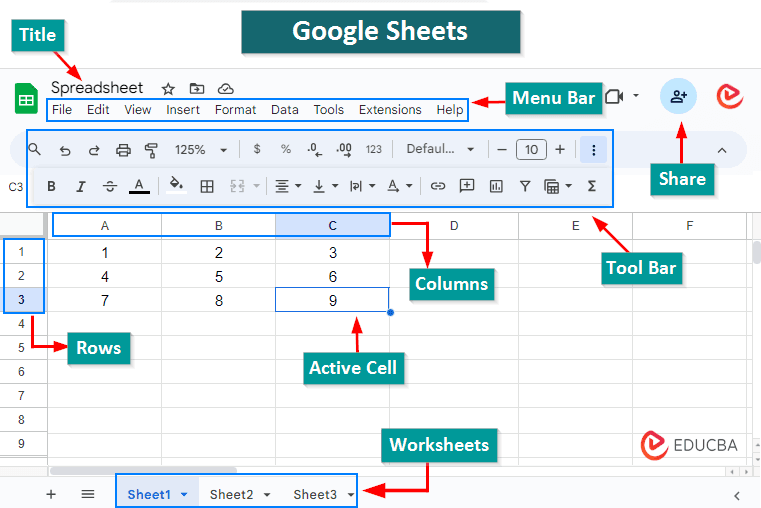
Google Sheets is a spreadsheet tool that can be used to organize the structured data behind programmatic SEO pages. It is particularly practical for smaller datasets, straightforward page templates, and teams that want an accessible way to manage content variables before connecting them to a publishing workflow.
Key features:
- It lets teams organize page data and variables in rows and columns.
- It supports formulas for transforming and combining data across fields.
- It allows multiple team members to edit and review datasets collaboratively.
- It can be connected to other tools and workflows through integrations and automation platforms.
- It provides filters and sorting options for managing large sets of page records.
Pros:
- It is familiar and easy for most teams to work with.
- It works well for straightforward datasets and smaller programmatic SEO projects.
- Its collaborative features make it useful for content and SEO teams working together.
Cons:
- It becomes harder to manage as datasets and relationships become more complex.
- It does not provide the database structure of tools such as Airtable or Supabase.
- Large-scale workflows may require additional tools for automation and publishing.
Why use Google Sheets for programmatic SEO?
Google Sheets can work as a simple data source for programmatic SEO workflows when the underlying dataset is relatively straightforward. For example, a business could maintain rows containing locations, product names, URLs, descriptions, and other variables that are later inserted into a page template.
It is particularly useful for testing a pSEO workflow before investing in more complex infrastructure. Once the dataset becomes larger or requires multiple related tables and more advanced automation, a dedicated database or data-management platform may be more suitable.
6. Supabase
Supabase is an open-source back-end platform built around PostgreSQL. For programmatic SEO, it can be used to store and manage the structured datasets that power large numbers of dynamically generated pages, particularly when the data is too complex or dynamic for a spreadsheet-based workflow.

Key features:
- It provides a PostgreSQL database for storing structured programmatic SEO data.
- It supports relational data, making it possible to connect related records such as products, locations, and categories.
- It provides APIs that can allow other applications to access and use the stored data.
- It supports authentication and access controls for managing database access.
- It can handle datasets that need to be updated frequently or queried dynamically.
Pros:
- It provides a more robust database structure than spreadsheets.
- Relational data makes it suitable for complex programmatic page systems.
- Its APIs make it easier to connect the dataset with applications and publishing workflows.
Cons:
- It requires more technical setup than Airtable or Google Sheets.
- Teams may need development resources to build and maintain the surrounding workflow.
- It does not provide a dedicated interface for creating or publishing programmatic SEO pages.
Why use Supabase for programmatic SEO?
Supabase can act as the database layer behind a programmatic SEO system. A website with thousands of pages could store information such as locations, products, categories, attributes, and relationships in a structured PostgreSQL database, then use that data to populate page templates.
It is particularly relevant when the dataset is large, frequently updated, or contains multiple related data types. Instead of treating the dataset as a static spreadsheet, teams can build a system where page data is queried and updated programmatically as the underlying information changes.
Template & Page Generation
7. SEOmatic
SEOmatic is a programmatic SEO platform designed to help teams create and publish landing pages from structured datasets and reusable templates. It provides a no-code approach to building pages at scale, making it relevant for teams that want to manage page generation without developing the entire system from scratch.

Key features:
- It lets users create reusable templates for programmatic landing pages.
- It can use structured datasets to populate page content and variables.
- It supports generating multiple pages from a single template.
- It provides tools for managing and publishing generated pages.
- It is designed to reduce the technical work involved in building a programmatic SEO system.
Pros:
- It brings data, templates, and page generation into a single workflow.
- Its no-code approach can make pSEO more accessible to marketers and SEO teams.
- It is purpose-built for creating pages at scale.
Cons:
- It may provide less flexibility than a fully custom development setup.
- Teams with highly complex data structures may still need external databases or integrations.
- The platform is focused on programmatic page creation rather than broader SEO research and monitoring.
Why use SEOmatic for programmatic SEO?
SEOmatic is useful at the template and page-generation stage of a programmatic SEO workflow. Instead of manually creating individual landing pages, teams can define a page structure once and use structured data to generate multiple variations from it.
For example, a business could create a template for location pages and populate it with different cities, services, descriptions, and other variables from its dataset. This makes SEOmatic more directly relevant to pSEO execution than tools such as Airtable or Google Sheets, which primarily help manage the data behind those pages.
8. Byword
Byword is an AI content generation platform designed to create and publish content at scale. For programmatic SEO, it can generate pages from structured inputs and predefined patterns, making it useful for teams that need to produce large volumes of search-focused content.

Key features:
- It generates content at scale from structured inputs and templates.
- It supports programmatic article and landing-page creation.
- It can generate content around different keywords, topics, and data points.
- It provides options for customizing generated content and page structures.
- It can connect generation with publishing workflows.
Pros:
- It can significantly reduce the manual work involved in producing large volumes of pages.
- It is designed specifically for content generation at scale.
- It can be useful when a programmatic workflow requires more than simple data insertion into a template.
Cons:
- AI-generated content still requires quality control and fact-checking before publication.
- It is more focused on content generation than dataset management or technical SEO.
- Large-scale publishing can create quality and differentiation issues if page inputs are too similar.
Why use Byword for programmatic SEO?
Byword is useful at the content-generation stage of a pSEO workflow. Instead of using the same fixed copy across hundreds of pages, teams can provide structured inputs and generate variations that are tailored to different keywords, topics, or datasets.
This can be useful when the page requires more substantial written content than a basic template can provide. However, the underlying data still needs to be accurate and sufficiently differentiated, and generated pages should go through quality control before being published at scale.
CMS & Publishing
9. Webflow
Webflow is a visual website builder and CMS that allows teams to create and manage structured content collections. For programmatic SEO, it can be useful to publish large sets of similar pages from CMS data, particularly when page structure and content fields follow a consistent format.

Key features:
- It lets teams create CMS collections with structured fields for page data.
- It can generate collection pages from individual CMS records.
- It supports reusable page structures and dynamic content fields.
- It provides controls for page titles, meta descriptions, URLs, and other SEO elements.
- It can integrate with external tools and data sources to support large publishing workflows.
Pros:
- Its visual CMS makes structured page publishing accessible to non-developers.
- CMS collections provide a straightforward way to manage repeated page structures.
- It combines page design, content management, and publishing in one platform.
Cons:
- Its native CMS capabilities may not be sufficient for highly complex pSEO systems.
- Large or frequently changing datasets may require external tools or integrations.
- It is a general website platform rather than a dedicated programmatic SEO solution.
Why use Webflow for programmatic SEO?
Webflow can serve as the CMS and publishing layer of a programmatic SEO workflow. Teams can create a CMS collection with fields such as location, service, description, URL, and metadata, then use a reusable template to publish individual collection pages.
It is particularly useful when the page structure is relatively consistent, and the team wants control over both design and publishing. For more complex pSEO systems, Webflow can be paired with external databases, automation tools, or custom workflows that manage the data and page generation before content reaches the CMS.
10. WordPress + Page Generator Pro
WordPress is a widely used content management system, while Page Generator Pro is a WordPress plugin designed for creating pages and posts in bulk. Together, they can support programmatic SEO workflows where teams need to generate and publish large numbers of structured pages within WordPress.
Key features:
- Page Generator Pro can create multiple pages or posts from predefined templates.
- It can use datasets and variables to populate different page elements.
- WordPress provides the CMS infrastructure for managing and publishing the generated pages.
- Teams can define page titles, content, URLs, and other SEO elements as part of the publishing workflow.
- Generated pages can be managed and edited through the existing WordPress environment.
Pros:
- It allows teams to run a pSEO workflow within an established WordPress setup.
- Page templates and variables can reduce the manual work involved in creating repeated pages.
- WordPress provides a large ecosystem of plugins and integrations for extending the workflow.
Cons:
- Large-scale page generation can require careful hosting and performance management.
- Complex datasets may require additional tools or custom development.
- Generating pages in bulk does not guarantee that every page will provide unique or useful search value.
Why use WordPress + Page Generator Pro for programmatic SEO?
This combination is useful at the page-generation and publishing stage of a pSEO workflow. Teams can create a reusable WordPress template, connect it to structured inputs, and generate multiple pages without manually building each one.
It can be particularly practical for businesses already using WordPress that want to add programmatic pages without moving to a separate CMS. The underlying dataset and page logic still need to be planned carefully, especially when generating pages at a large scale.
QA, Indexing & Monitoring
11. Screaming Frog
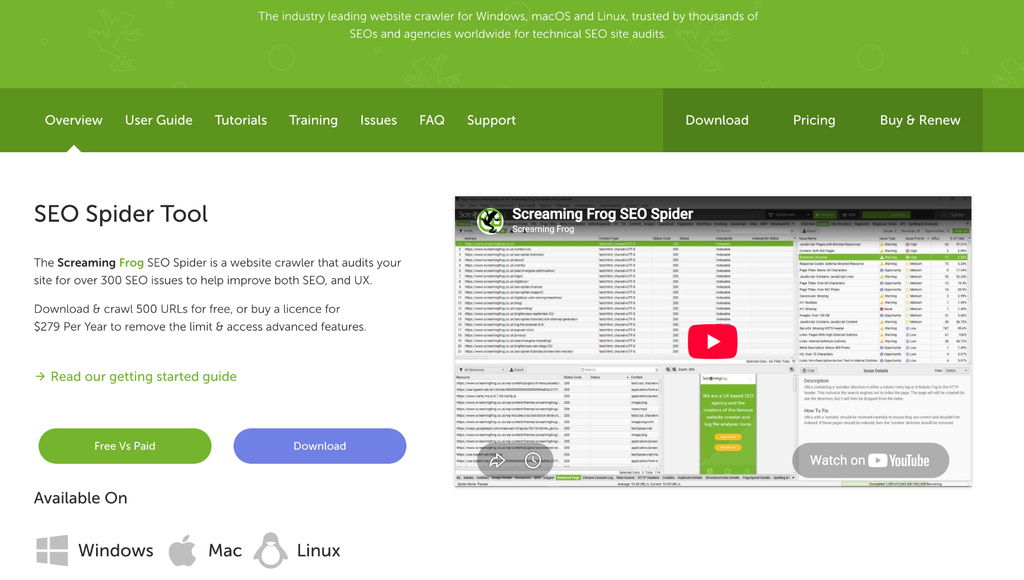
Screaming Frog SEO Spider is a website crawler that can analyze large websites for technical SEO issues. For programmatic SEO, it is particularly useful for checking large numbers of generated pages for broken links, missing metadata, duplicate elements, indexing issues, and other technical problems.
Key features:
- It crawls websites and analyzes pages, links, metadata, and other technical elements.
- It identifies broken links, redirects, missing or duplicate metadata, and other common issues.
- It can crawl large numbers of URLs to identify problems across programmatic page sets.
- It provides data that can be exported for further analysis and review.
- It supports custom extraction and configuration for more advanced technical audits.
Pros:
- It is well suited to checking large numbers of URLs efficiently.
- It can help identify technical issues that may be difficult to spot through manual reviews.
- Its crawl data can be useful for validating whether generated pages have been published correctly.
Cons:
- It is primarily a technical auditing tool, not a programmatic page-generation platform.
- Large websites can require crawl configuration and resource management.
- It does not assess whether generated content is genuinely useful or differentiated from an editorial perspective.
Why use Screaming Frog for programmatic SEO?
Screaming Frog is useful at the quality-control stage of a programmatic SEO workflow. Once hundreds or thousands of pages have been generated, a crawl can help identify issues such as broken URLs, missing title tags, duplicate metadata, redirect problems, or pages that cannot be reached through the site’s internal linking structure.
This makes it particularly useful before and after publishing a large page set. It can help validate the technical health of the pages, although content quality and search performance still need to be assessed separately.
12. Google Search Console
Google Search Console is a free Google tool for monitoring how a website appears in Google Search. For programmatic SEO, it can help teams track indexing, search visibility, clicks, impressions, and query performance across large sets of pages.
Key features:
- It shows which pages Google has indexed and reports on indexing issues.
- It provides clicks, impressions, click-through rate, and average position for search queries and pages.
- It lets teams analyze which queries are driving traffic to different page groups.
- It provides reports for issues that may prevent pages from appearing properly in Google Search.
- It allows teams to inspect individual URLs and check their indexing status.
Pros:
- It provides first-party data on how pages perform in Google Search.
- It is useful for monitoring large groups of programmatic pages after publication.
- It can help identify indexing problems and pages that are not generating search visibility.
Cons:
- It does not generate, manage, or optimize programmatic pages.
- Search Console data is primarily useful after pages have been published and crawled.
- It provides less detailed competitor and keyword research data than dedicated SEO platforms.
Why use Google Search Console for programmatic SEO?
Google Search Console is useful at the measurement and monitoring stage of a programmatic SEO workflow. Once a set of pages is live, teams can use it to check whether Google is indexing them and analyze impressions, clicks, CTR, and search queries across the page set.
This data can also help identify patterns within a programmatic strategy. If one group of pages is receiving impressions while another is not, teams can investigate differences in search demand, content, internal linking, or indexing. This makes Search Console an important feedback loop for refining templates and deciding which page patterns to maintain, update, or reconsider.
Programmatic SEO Tools vs AI Content Tools
Programmatic SEO and AI content generation can overlap, but they solve different problems. Programmatic SEO is primarily about building and managing a system for creating a set of pages, while AI content tools are primarily focused on generating written content.
| Programmatic SEO | AI content generation |
| Starts with structured datasets | Often starts with keywords, prompts, or briefs |
| Uses reusable page templates | Usually generates individual pieces of content |
| Designed to create and manage page sets | Designed primarily to create content |
| Uses variables that change from page to page | Changes content based on the prompt or context |
| Often connects to a CMS, database, or publishing system | May publish directly or export generated content |
| Requires data and page architecture | Requires prompts, instructions, or content inputs |
Which Tool Should You Choose?
| Your situation | Tools to consider | Why |
| You are still validating whether a pSEO opportunity exists | Ahrefs, Semrush, Keyword Chef | Research search demand, keyword patterns, competition, and long-tail opportunities before building pages. |
| You have a large dataset but no clear way to organize it | Airtable, Google Sheets | Structure and manage the variables that feed your page templates. |
| Your data is complex, relational, or frequently updated | Supabase | Provides database infrastructure for larger and more dynamic datasets. |
| You want to generate pages without building the system from scratch | SEOmatic | Provides a more direct workflow for creating programmatic pages from structured inputs. |
| Your pages need AI-generated enriched copy | Byword | Adds AI-assisted content generation to a scalable page workflow. |
| Your main challenge is publishing structured pages through a CMS | Webflow | Uses CMS collections and reusable structures to manage repeated page types. |
| Your website already runs on WordPress | WordPress + Page Generator Pro | Lets you add bulk page generation to an existing WordPress workflow. |
| You have already generated a large number of pages and need to check them | Screaming Frog | Crawls the site to identify technical and structural issues across the page set. |
| Your pages are live, and you want to measure what happened | Google Search Console | Shows indexing and search-performance data for published pages and queries |
Programmatic SEO works best when the tools match the workflow behind it. Keyword research can help identify viable page patterns, structured datasets provide the underlying information, templates and page-generation tools create pages at scale, and QA and monitoring help manage what happens after publication.
There is no single tool that needs to handle every stage. The right combination depends on your data, CMS, technical setup, and how much of the workflow you want to automate.
Explore our other guides on AI and search optimisation:
- GSC Claude Connector Servers: Which Ones Are Worth Connecting
- How to Analyze the Amazon Search Query Performance Report: A Complete Guide with Free Claude Skill
- Best Keyword Research MCP Servers in 2026: Compared and Ranked
FAQs
No. Most pSEO workflows need only a few tools. The right combination depends on your dataset, CMS, technical setup, and which parts of the workflow you want to automate.
You can connect datasets through native integrations, APIs, automation platforms, or custom development. The right approach depends on your dataset, CMS, and page-generation tool.
Use a page-generation tool or custom workflow that pulls data into reusable templates and sends the resulting pages to your CMS. Add a review or QA step before automatic publishing.
Yes, for smaller projects. Google Sheets, Google Search Console, and free or limited versions of some SEO tools can cover parts of the workflow, but larger projects may require paid tools or development resources.
Disclosure – This post contains some sponsored links and some affiliate links, and we may earn a commission when you click on the links, at no additional cost to you.