AI agents increasingly need reliable access to web-based information, whether they are researching content, monitoring websites, comparing prices, or handling other high-volume web tasks. But accessing websites at scale can create challenges around IP restrictions, geographic availability, request limits, and maintaining consistent sessions.
Proxies can help address some of these challenges by routing requests through different IP addresses and locations. Depending on the proxy type and provider, they can support geographic targeting, IP rotation, session persistence, and large volumes of requests.
With more proxy providers offering services designed for automation and AI workloads, choosing the right option can get tricky. In this guide, we compare six proxy providers based on factors such as proxy types, geographic coverage, IP rotation, performance, scalability, and pricing.
Quick Answer
| Proxy Provider | Best For | Key Advantage |
| DataImpulse | Cost-conscious workloads | Low-cost, pay-as-you-go proxy access |
| Bright Data | Enterprise-scale AI agents | Large network and advanced targeting |
| Oxylabs | Large-scale data collection | Extensive proxy network and enterprise infrastructure |
| Decodo | AI and automation workflows | Strong balance of price, coverage, and tooling |
| SOAX | Geographic targeting | Detailed location and session controls |
| Webshare | Budget-conscious setups | Low-cost plans and easy setup |
What Are Proxies for AI Agents?
A proxy acts as an intermediary between an AI agent and the website it accesses. Instead of connecting directly to a website, the agent sends its request through a proxy server, which then forwards the request to the destination.
This can be useful when an AI agent needs to access websites repeatedly, work with location-specific information, or handle large volumes of requests. Common use cases include:
- Website research: Accessing information from multiple websites during automated research tasks.
- Data collection: Sending requests at scale when gathering information from public web sources.
- Competitor monitoring: Tracking competitor websites, products, content, or search visibility over time.
- Price and product monitoring: Checking product availability, pricing, and changes across different websites.
- Search-result monitoring: Checking search results from different locations or at regular intervals.
- Location-specific research: Accessing websites or content that varies based on the user’s geographic location.
- Browser automation: Supporting automated browsing sessions that need different IP addresses, locations, or persistent connections.
Proxies mainly handle the networking side of these tasks. Depending on the provider, they can route requests through different IP addresses and locations, rotate IPs, and maintain persistent sessions.
How We Compared These AI Agent Proxies
| Criteria | What We Looked For |
| Proxy types | Residential, datacenter, mobile, ISP, and other proxy options available |
| Geographic coverage | Countries, cities, and locations available for targeted requests |
| Rotation and sticky sessions | Options for rotating IPs and maintaining the same IP for a session |
| Concurrency and scale | Support for simultaneous connections and high-volume workloads |
| Protocols/API support | Supported protocols, APIs, SDKs, and integration options |
| Reliability | Uptime, connection stability, success rates, and overall consistency |
| AI-agent suitability | How well the provider fits research, monitoring, automation, and other AI-agent workloads |
| Pricing | Pricing structure, starting rates, bandwidth costs, and available plans |
Comparison Table of Best Proxies for AI Agents
| Provider | Best For | Protocols/API | Standout Feature |
| DataImpulse | Cost-conscious AI-agent workloads | HTTP, HTTPS, SOCKS5, API | Low-cost pay-as-you-go residential proxies |
| Bright Data | Enterprise-scale AI agents | HTTP, HTTPS, SOCKS5, APIs | Large proxy network and broad web-data infrastructure |
| Oxylabs | Large-scale web research and data collection | HTTP, HTTPS, SOCKS5, APIs | Enterprise-grade proxy and web data infrastructure |
| Decodo | All-round AI-agent workloads | HTTP(S), SOCKS5, APIs | Proxy network combined with AI and scraping tools |
| SOAX | Location-specific research | HTTP, HTTPS, SOCKS5, API | Granular geographic targeting and session controls |
| Webshare | Budget-conscious workloads | HTTP, SOCKS5, API | Affordable self-serve plans and free tier |
Best Proxies for AI Agents
| Table of Contents |
| 1. DataImpulse |
| 2. Bright Data |
| 3. Oxylabs |
| 4. Decodo |
| 5. SOAX |
| 6. Webshare |
1. DataImpulse
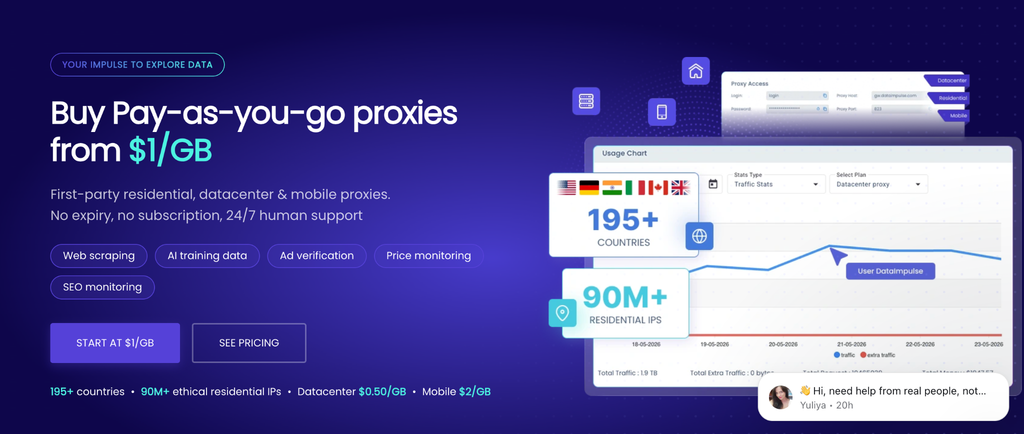
DataImpulse is a proxy provider offering infrastructure for businesses that need reliable access to websites for automation, research, and data collection. Its network includes residential, mobile, datacenter, and premium residential proxies, giving users different options depending on their workload. The provider covers more than 195 countries and supports both rotating and sticky sessions for different types of web access. It also offers geographic targeting and API support for workflows that require automated proxy management. With pay-as-you-go pricing and support for high-volume requests, DataImpulse can be suitable for AI agents that need flexible proxy access without committing to a fixed monthly plan.
Key Features:
- DataImpulse offers residential, mobile, datacenter, and premium residential proxies across more than 195 countries.
- Its residential network includes more than 90 million IPs, with options for both rotating and sticky sessions.
- Users can target specific countries, cities, ZIP codes, states, and ASNs depending on the proxy type.
- It supports HTTP, HTTPS, and SOCKS5 protocols, along with API access for automated workflows.
- The service integrates with tools and frameworks such as Scrapy, Puppeteer, Selenium, and Playwright.
- Its pay-as-you-go pricing starts at $1/GB for residential proxies, with unused traffic that does not expire.
Why Choose DataImpulse?
DataImpulse is worth considering for AI agents that need a combination of geographic flexibility, IP rotation, and predictable session control. Its rotating sessions can provide a new IP for each request, while sticky sessions allow an agent to maintain the same IP during workflows where session consistency matters.
Its pay-as-you-go model is another advantage for workloads that vary in volume, since unused traffic does not expire and there is no requirement for a monthly subscription. The combination of residential and datacenter proxies also gives teams flexibility to choose between broader IP diversity and lower-cost, high-volume requests depending on the task.
2. Bright Data
Bright Data is a web data and proxy provider offering infrastructure for businesses that need reliable access to websites at scale. Its proxy network includes residential, mobile, ISP, and datacenter proxies, with coverage across a wide range of countries and locations. The platform provides controls for IP rotation, session persistence, and geographic targeting, making it suitable for different types of automated web access. It also offers APIs and web data tools alongside its proxy services, which can be useful for AI-agent workflows that involve research and data collection. For larger workloads, Bright Data provides infrastructure designed to handle high request volumes and concurrent connections.
Key Features:
- Bright Data offers residential, mobile, ISP, and datacenter proxies for different web access and data collection needs.
- Its residential network includes more than 400 million IPs across 195 countries, with country, city, ZIP code, carrier, and ASN targeting.
- It supports both rotating and sticky sessions, giving users control over IP changes and session persistence.
- Bright Data supports HTTP/S and SOCKS5, along with APIs and a Proxy Manager for managing proxy traffic.
- Its proxy infrastructure is designed for large-scale workloads, with the company reporting 99.99% network uptime and a 99.95% success rate.
- Pay-as-you-go options are available across its residential, ISP, datacenter, and mobile proxy network.
Why Choose Bright Data?
Bright Data is a strong option for AI agents that need large-scale web access and detailed control over proxy locations and sessions. Its broad IP network and geographic targeting make it suitable for workloads such as web research, competitor monitoring, ecommerce data collection, and location-specific research.
It also has a broader web-access ecosystem beyond proxies, including APIs for search, browsing, and web data extraction. This can be useful when an AI-agent workflow needs more than basic IP routing and requires additional infrastructure for accessing and collecting web data.
3. Oxylabs
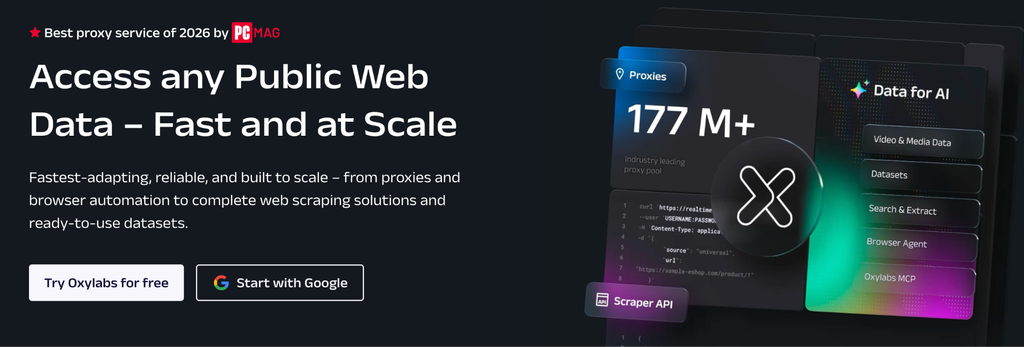
Oxylabs is a global proxy and web data provider offering a range of proxy solutions for businesses that need reliable access to public web data at scale. Its network includes residential, mobile, ISP, and datacenter proxies, with coverage across 195 countries and city-level targeting options. The provider also supports different session and rotation requirements, allowing users to choose between rotating IPs and more persistent connections. Alongside its proxy infrastructure, Oxylabs offers APIs and integrations for automated data collection and browser-based workflows. It also provides dedicated resources for connecting AI agents to its proxy services, making it particularly relevant for agent-based research and data collection.
Key Features:
- Oxylabs offers residential, mobile, ISP, and datacenter proxies for different web access and data collection requirements.
- Its proxy network covers 195 countries, with targeting available at country, city, state, ZIP code, ASN, and coordinate levels depending on the proxy type.
- Residential proxies provide access to more than 175 million IPs, while its mobile network includes more than 20 million IPs across 140+ countries.
- Oxylabs supports HTTP, HTTPS, and SOCKS5 protocols, with some products also supporting HTTP/3 and QUIC.
- Its proxy products support IP rotation and sticky or static sessions, depending on the proxy type and use case.
- Oxylabs integrates with tools such as Selenium, Puppeteer, Playwright, and Scrapy, and also provides APIs for automated data collection.
- Its Agent Skills are designed to help AI agents connect to Oxylabs proxies and work with tools such as Claude, Cursor, and Copilot.
Why Choose Oxylabs?
Oxylabs is a strong option for AI agents that need large-scale web access, broad geographic coverage, and multiple proxy types. Its combination of residential, mobile, ISP, and datacenter proxies allows teams to choose infrastructure based on factors such as location, speed, session requirements, and the type of websites an agent needs to access.
Its AI-agent support is another notable advantage. Oxylabs provides dedicated Agent Skills for connecting AI agents to its proxy infrastructure, alongside integrations with common browser automation and scraping tools. This can make it a practical choice for teams building automated research, monitoring, and data-collection workflows rather than using proxies as a standalone service.
4. Decodo
Decodo is a proxy and public data access provider offering infrastructure for web scraping, automation, and AI-driven data workflows. Its network includes residential, mobile, ISP, and datacenter proxies, with coverage across more than 195 locations. The platform supports both rotating and sticky sessions, allowing users to switch IPs between requests or maintain a consistent identity for longer workflows. Decodo also offers web scraping and AI-focused tools alongside its proxy network, including an MCP Server, AI Parser, and integrations with LangChain and n8n. This makes it particularly relevant for AI agents that need to access, collect, and work with live web data.
Key Features:
- Decodo offers residential, mobile, ISP, and datacenter proxies for different web access and automation requirements.
- Its network includes more than 125 million IPs across 195+ locations, with city and geographic targeting options.
- It supports both rotating and sticky sessions for workloads that require changing IPs or maintaining a consistent session.
- Decodo supports HTTP(S) and SOCKS5 protocols and provides integrations and setup options for common development tools.
- Its AI-focused infrastructure includes an MCP server, AI Parser, and integrations with LangChain and n8n for agent and data workflows.
- Its proxy network supports use cases such as SERP monitoring, ecommerce research, price monitoring, and large-scale data collection.
- Decodo reports 99.99% uptime for its proxy infrastructure and offers 24/7 technical support.
Why Choose Decodo?
Decodo is a strong option for AI agents that need proxy access alongside tools for collecting and processing web data. Its combination of proxies gives teams flexibility to choose infrastructure based on factors such as geographic targeting, session requirements, speed, and the type of websites being accessed.
Its dedicated AI infrastructure is another advantage. Decodo provides an MCP Server and AI Parser alongside its proxy and scraping products, allowing agents to collect public web data, turn it into structured outputs, and use it within agent workflows. This makes it useful for applications such as real-time research, RAG pipelines, monitoring, and automated data collection.
5. SOAX
SOAX is a proxy and web data provider offering residential, mobile, ISP, and datacenter proxies for businesses that need reliable access to public web data. Its residential and mobile networks cover more than 195 locations, with targeting available at the country, region, city, and ASN levels. The platform supports both rotating and sticky sessions, giving users control over how often IP addresses change during a workflow. SOAX also provides API access and a Web Data API for collecting structured web data without managing the entire scraping infrastructure themselves. With support for high concurrency and AI-focused data collection, SOAX can be a suitable option for AI agents handling research, monitoring, and large-scale web data tasks.

Key Features:
- SOAX offers residential, mobile, ISP, and datacenter proxies for different web access and data collection requirements.
- Its residential network includes more than 155 million IPs across 195+ locations, with targeting available at the region, city, and ASN levels.
- It supports rotating and sticky sessions, with options to rotate IPs per request or maintain the same IP for a defined session.
- SOAX supports HTTP, HTTPS, and SOCKS5, with API access for programmatic proxy management.
- Its proxy infrastructure supports unlimited concurrent sessions, making it suitable for high-volume automated workloads.
- The Web Data API can return web data in formats including HTML, JSON, Markdown, XHR responses, and screenshots.
- SOAX specifically positions its infrastructure for AI and LLM data workflows, including collecting web data for generative AI models.
Why Choose SOAX?
SOAX is worth considering for AI agents that need flexible location targeting, session control, and high-volume web access. Its residential and mobile networks cover a broad range of locations, while its rotation controls allow an agent to switch between IPs between requests or maintain a consistent connection when a workflow requires session persistence.
Its Web Data API also makes SOAX more than a basic proxy provider. Agents can use the API to collect web data in formats such as JSON, Markdown, or HTML, while SOAX handles elements such as proxy selection, retries, and browser-related requirements. This can be useful for AI-agent workflows involving web research, ecommerce monitoring, pricing data, and large-scale data collection.
6. Webshare
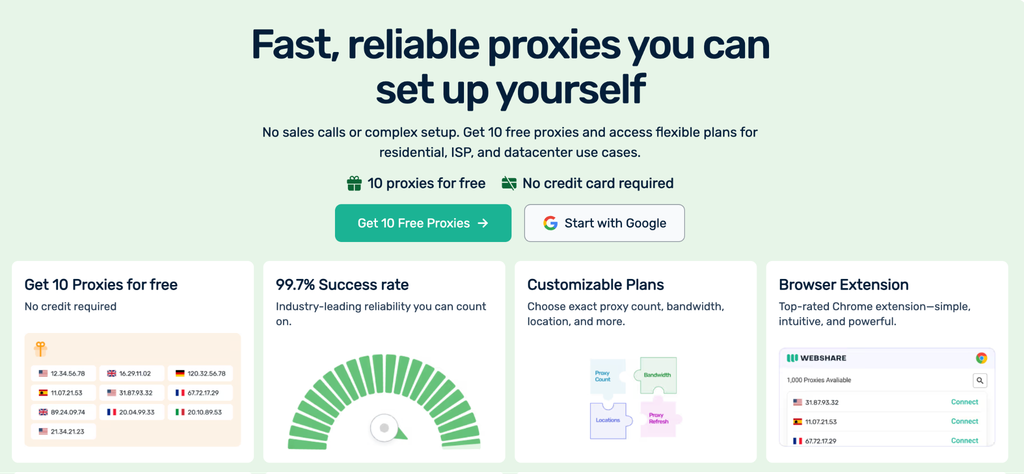
Webshare is a proxy provider focused on affordable, easy-to-configure proxy infrastructure for web scraping, automation, research, and monitoring. Its network includes datacenter, static residential, and rotating residential proxies, giving users options for both high-speed requests and location-specific access. The provider offers IPs across 195 countries, with additional targeting options such as city, state, ZIP code, and ASN for its rotating residential network. Webshare also provides HTTP and SOCKS5 support, API access, and configurable rotation and session options. Its combination of low-cost plans, a free starting tier, and scalable proxy infrastructure makes it an option worth considering for AI agents with variable workloads.
Key Features:
- Webshare offers datacenter, static residential, and rotating residential proxies for different automation and web-access requirements.
- Its rotating residential network includes more than 80 million IPs across 195 countries, with city, US state, ZIP code, and ASN targeting.
- Users can choose between rotating and sticky sessions depending on whether a workflow needs IP diversity or session continuity.
- Webshare supports HTTP and SOCKS5 protocols and provides REST API access for programmatic proxy management.
- Its proxy infrastructure supports high-volume workloads, with plans offering up to 3,000 threads and unlimited bandwidth options.
- Webshare offers a free plan with 10 proxies, while paid proxy plans start at $2.99 per month.
- The provider reports 99.97% network uptime and checks its proxy servers regularly for stability and performance.
Why Choose Webshare?
Webshare is worth considering for AI agents that need affordable proxy infrastructure with straightforward setup and flexible scaling. Its combination of datacenter, static residential, and rotating residential proxies allows teams to choose between spend, session stability, and IP diversity depending on the workload. The broad geographic coverage can also support agents performing location-specific research, SERP monitoring, ecommerce tracking, and other automated web tasks.
Its pricing and developer-friendly setup are other advantages. The free tier allows teams to test the service before committing, while API access and configurable proxy lists make it relatively simple to integrate into automated workflows. For AI-agent workloads that need large numbers of requests without requiring a broader web-data platform, Webshare can be a practical and cost-conscious option.
Rotating vs. Sticky Proxies for AI Agents
| Use rotating proxies when… | Use sticky sessions when… |
| Requests are independent | The agent performs multiple steps |
| The agent collects unrelated pages or datasets | Cookies or session state need to persist |
| You need greater IP diversity | The same locations should remain consistent |
| Session state does not matter | The workflow involves multiple requests to the same site |
| High-volume requests need frequent IP changes | The agent needs to maintain an authenticated session |
Don’t Rotate Just Because You Can
Changing the IP during a multi-step workflow can cause authentication issues, lost sessions, inconsistent localizations, additional verification, or failed transactions.
Simple rule: Rotate for independent requests; use sticky sessions when the workflow depends on continuity.
Best Proxies for AI Agents by Use Case
| If you need… | Consider |
| Enterprise-scale proxy infrastructure | Bright Data/Oxylabs |
| Cost-conscious setup | Decodo/Webshare |
| Geographic targeting | SOAX/Bright Data |
| Large-scale data collection | Bright Data/Oxylabs |
| Simple AI-agent prototype | Webshare/Decodo |
| Residential IP access | DataImpulse/Bright Data/Decodo |
| Mobile proxy workflows | SOAX/Oxylabs/Bright Data |
| Complex production agent infrastructure | Bright Data/Oxylabs |
The best proxy for an AI agent depends on the workload, not simply the size of the proxy network. Consider what the agent accesses, whether location and session continuity matter, how much traffic it generates, and how much control you need. For simple or budget-conscious setups, providers such as Webshare and Decodo can be practical starting points, while Bright Data and Oxylabs are better suited for larger, more complex workloads.
Looking for more ways to build and optimize AI workflows? Explore our other guides:
- GSC Claude Connector Servers: Which Ones Are Worth Connecting
- Best YouTube MCP Servers for Claude in 2026: Which One Should You Use?
- How to Build a Competitor Price Monitoring System Using Proxies and AI
FAQs
Most proxy providers offer APIs or proxy endpoints that let you rotate IPs automatically. You can configure rotation per request, after a set interval, or based on specific workload conditions.
It should last only as long as the workflow needs the same IP. Short sessions may be enough for simple tasks, while multi-step or authenticated workflows may require longer sessions.
A well-designed agent should detect failed requests and retry through another proxy or endpoint. Providers may also offer automatic retries, health checks, and IP replacement to reduce failures.
It depends on the workflow. Use rotating proxies for independent requests, sticky sessions for multi-step workflows, and dedicated proxies when an agent needs a consistent IP over longer periods.
Disclosure – This post contains some sponsored links and some affiliate links, and we may earn a commission when you click on the links, at no additional cost to you.