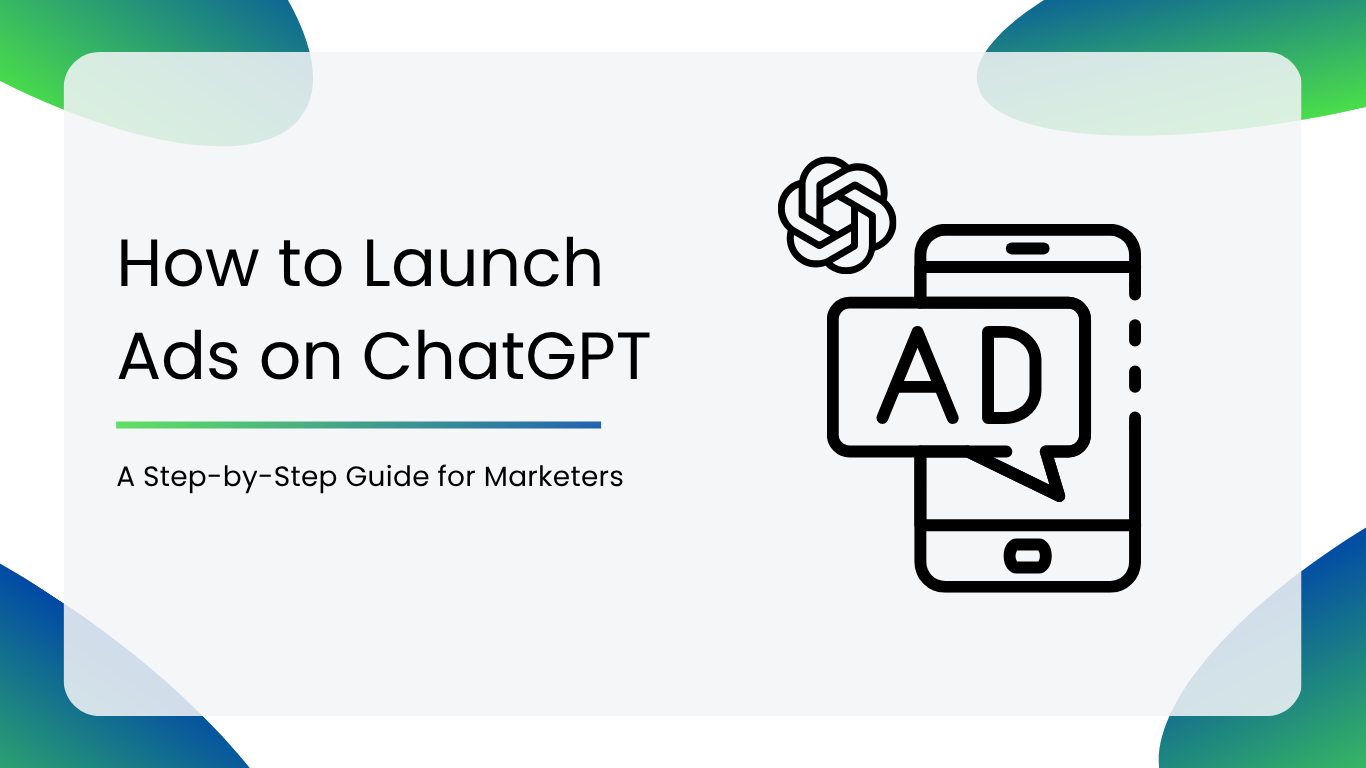
ChatGPT Ads offer marketers another way to reach potential customers, but launching them is not simply a matter of copying an existing Google Ads campaign into a new platform.
Google Search Ads are built around explicit search queries and keywords. ChatGPT Ads operate within conversations, where relevance can depend on the user’s conversational context and other signals. That changes how marketers need to think about targeting, creative, and campaign optimization.
For marketers already familiar with Google Ads, the underlying principles are still useful: define the objective, understand the customer, build a relevant offer, track conversions, and test systematically. The main difference is how you connect an ad to user intent.
Table of Contents
What Are ChatGPT Ads?
ChatGPT Ads are paid placements that appear within ChatGPT. They give businesses another paid channel for reaching users in an AI conversation rather than a traditional search results page or social feed.
The distinction is important:
| Factor | Google Ads | Meta Ads | ChatGPT Ads |
| Environment | Search/results pages | Social feeds | AI conversations |
| Traditional keyword targeting | Yes | No | No |
| Main relevance signals | Search query, keywords, audience | User/profile/content signals | Conversational context and other relevance signals |
| Common formats | Search, display, video, shopping | Image, video, carousel, etc. | Static and product-focused formats |
| Typical intent | Explicit search intent | Demand creation/discovery | Conversational intent |
In simpler terms, you are advertising inside a conversation, not simply against a keyword or inside a feed.
Before You Launch: Research Your Competitors
The objective is not to copy those ads into ChatGPT. Instead, look for patterns:
| What to analyze | What it can tell you |
| Headlines | Core positioning |
| Offers | What encourages action |
| CTAs | Desired next step |
| Repeated claims | Common category messaging |
| Regional variations | Local positioning |
| Creative formats | How competitors package information |
You can also make this research faster by bringing competitor advertising data into Claude. Smacient’s Google Ads Library Claude Connector can help marketers analyze advertising data across advertisers, regions, and creatives using conversational prompts.
A simple workflow is:
Google Ads Transparency Center → Competitor ads → Claude analysis → Messaging gaps → ChatGPT ad ideas
Step 1: Check Whether Your Business Can Advertise on ChatGPT
Before creating a campaign, check whether your business and intended advertising category are eligible.
OpenAI’s advertising policies restrict certain products, services, claims, and types of advertising. Political advertising is not allowed, while some regulated categories may be eligible subject to additional requirements. Ads may also be restricted from appearing alongside certain sensitive or regulated conversations.
Availability and requirements can change as the advertising platform develops, so check the current OpenAI advertising policies and Ads Manager availability before planning a campaign.
Budget is another consideration. OpenAI currently lists a minimum daily budget of ₹725 for campaigns billed in INR. Other currencies have different minimums, and recommended bids can change as the platform evolves.
Treat your first campaign budget as a test budget rather than assuming your Google Ads budget should simply carry over.
Step 2: Set Up Your ChatGPT Ads Account
You can create an advertiser account through Ads Manager and either create a campaign during setup or enter Ads Manager and build later.
Before starting, have these ready:
- Legal business name
- Business or tax information, where required
- Payment method
- Business website
- Business logo
- Access for the people managing the account
The advertiser name you initially provide is used to establish account and brand information, although the Account Name, Brand Name, and Legal Name can be managed separately later.
If several people are working on campaigns, the account owner can invite other users with appropriate permissions. For agencies, keeping the advertiser account client-owned and giving the agency team access is generally the cleaner setup.
Billing information also needs to be configured before campaigns can deliver.
Step 3: Build Your Campaign Structure
The basic structure is:
Campaign → Ad Group → Ad
At the campaign level, you set the broad parameters, including:
- Campaign objective
- Locations
- Audience options
- Budget
- Conversion event
- Start and end dates
At the ad group level, you can organize different approaches and configure elements such as bids, destination URLs, and context hints.
At the ad level, you create the actual creative, including the headline, description, image, and destination URL.
For a first campaign, you do not need a complicated structure. A useful starting point could be one campaign with two or three ad groups representing distinct customer contexts, with two or three ads testing different messages.
The goal is to create enough variation to learn without making the results unnecessarily difficult to interpret.
Step 4: Choose How You Want to Bid
ChatGPT Ads currently supports campaign objectives including Clicks, Views, and Conversions.
- Clicks: Optimizes toward traffic and uses CPC bidding.
- Views: Optimizes toward exposure and uses CPM bidding.
- Conversions: Optimizes toward a defined conversion event when conversion tracking is configured.
For CPC campaigns, OpenAI currently recommends starting with a maximum CPC bid of $3-$5. This is a starting recommendation, not a universal benchmark. Your actual bid strategy should depend on campaign performance, conversion data, and the value of the customer you are acquiring.
ChatGPT Ads use a relevance-weighted auction, so the highest bid does not automatically determine which ad wins. Factors such as the ad, landing page, context hints, and relevance to the current conversation can influence delivery.
This is similar to Google Ads in one important respect: bid alone is not enough. But the two systems should not be treated as identical because the source of intent is different.
Step 5: Target Conversations Instead of Keywords
ChatGPT Ads don’t use traditional keyword targeting in the way Google Search Ads do.
Instead, marketers can work with signals such as geographic targeting, supported first-party/custom audiences, context hints, ad copy, and landing-page relevance.
What are context hints?
Context hints are information provided at the ad-group level to describe the conversations, topics, needs, or situations in which an ad is relevant.
They are not exact-match keywords or guaranteed delivery rules.
For example, a running-shoe brand could use:
“Cushioned everyday running shoes for beginners training for their first 5K.”
A plumbing company could describe:
“After-hours residential plumbing services for urgent repairs in Chicago.”
You can use keyword-like phrases, questions, or more natural descriptions of customer situations. Keyword research can still help you understand how people describe their needs, but those keywords do not function as traditional keyword bids.
For example:
Keyword-style
Lumber yard near me
Buy 2x4s
Cedar decking
Question-style
Where is the closest lumberyard?
What is the most cost-effective decking material?
Conversational context
I want to target DIY homeowners in San Antonio looking for high-quality cedar planks for decking projects.
The important shift is from asking “Which keyword should trigger my ad?” to “In what kind of conversation would my product be genuinely relevant?”
Step 6: Create Your ChatGPT Ads
For a static ad, you’ll typically work with:
- Headline
- Description
- Image
- Destination URL
Your advertiser name and favicon/logo can also appear with the ad.
The copy should not simply reproduce your Google Search Ads. Instead, start with the problem or need the user is discussing and connect it to a clear value proposition.
A simple framework is:
Problem → Relevance → Value → Action
For example, rather than writing generic copy around “best accounting software,” build the message around a situation such as a small business struggling with invoices, bookkeeping, or switching platforms.
For product campaigns, structured product-feed information can be used to create product-focused ads at scale. This is particularly relevant for ecommerce businesses with larger catalogues, where maintaining individual creative for every product may not be practical.
Your landing page should reinforce the same promise made in the ad. A mismatch between the conversational context, ad copy, and landing page can make it harder to turn clicks into meaningful actions.
Step 7: Set Up Conversion Tracking Before You Launch
If your objective is conversions, set up measurement before spending significant budget.
OpenAI supports both the OpenAI Pixel and Conversions API for conversion measurement. These can be used to send events such as page views and other actions, along with conversion values where relevant.
If you use both Pixel and Conversions API, event IDs can be used to help deduplicate the same conversion.
You should also use UTM parameters on your destination URLs so that traffic can be analyzed in GA4 and other analytics platforms.
For example:
utm_source=chatgpt
utm_medium=paid
utm_campaign=campaign_name
Key metrics to monitor include:
| Metric | What it tells you |
| Impressions | How often ads were shown |
| Clicks | Traffic generated |
| CTR | Click engagement |
| CPC | Cost of traffic |
| CPM | Cost of exposure |
| Conversions | Desired business actions |
| Conversion rate | Quality of traffic |
| CPA | Cost of acquisition |
Step 8: Launch Your Campaign
Before launching, run through a simple checklist:
- Business and advertiser account approved
- Campaign objective selected
- Geography configured
- Budget and bid set
- Ad groups created
- Context hints added
- Ads uploaded
- Landing pages checked
- Conversion tracking configured
- UTMs added
- Ads reviewed
Then launch the campaign and give it enough time to generate useful data before making multiple changes.
Your first campaign should be treated as a testing exercise, not a finished playbook.
Look at:
- Which contexts generate engagement?
- Which messages earn clicks?
- Are clicks turning into meaningful actions?
- Which audiences or locations respond?
- What should be tested next?
How to Optimize ChatGPT Ads When You Have Limited Data
You can test:
- Different context hints
- Headlines and descriptions
- Offers and CTAs
- Landing pages
- Geographic segments
- Bids
- Campaign structures
The most important rule is to avoid changing everything at once. If you change the context hints, creative, landing page, and bid simultaneously, it becomes difficult to understand what caused the result.
There is also information you should not expect to see. Advertisers do not get access to users’ private conversations or a conventional search-term report showing the exact conversational trigger behind every impression.
So instead of asking, “Which exact phrase triggered this ad?”, optimization becomes more about identifying which combinations of context, message, audience, and landing page perform better.
Keep a record of what you tested and why. Over time, that becomes more useful than making isolated changes based on individual results.
How ChatGPT Ads Compare With Google Ads
The biggest difference is the source of intent.
Google Search gives you an explicit search query and keyword framework. ChatGPT Ads operate in a conversational environment where relevance can depend on the broader context of the interaction.
That means a Google Ads marketer should not abandon keyword research, but should stop treating keywords as the central targeting mechanism.
Think of the transition as:
Google Ads: Query → Keyword → Ad → Landing Page
ChatGPT Ads: Conversation context → Relevance → Ad → Landing Page
How to Use the Google Ads Transparency Center Before Launching ChatGPT Ads
Google Ads research can be particularly useful when you don’t yet have enough ChatGPT campaign data to know what messaging works in your category.
Start with the Google Ads Transparency Center and look at competitors’ current and recent advertising. Pay attention to what they repeatedly say, rather than focusing on one individual ad.
Then use those observations to identify category conventions and potential gaps.
For example:
Competitor ads → Common claims → Overused positioning → Messaging gap → New ChatGPT ad angle
Smacient’s Google Ads Library Claude Connector can support this research by bringing competitor advertising data into Claude, where marketers can compare advertisers and analyze messaging patterns conversationally.
This creates a practical workflow for marketers entering a new advertising environment:
Research → Analyze → Identify gaps → Build context hints → Create ads → Test
ChatGPT Ads Testing Framework
Once the campaign is live, test one meaningful variable at a time.
| Test | Example |
| Context | Keyword-style vs. conversational description |
| Creative | Different headlines |
| Offer | Discount vs. free consultation |
| CTA | Learn more vs. Get started |
| Geography | Country vs. specific region |
| Landing page | Product page vs. category page |
| Bid | Different CPC caps |
For awareness, look at impressions and CPM. For traffic, focus on clicks, CTR, and CPC. For conversion campaigns, prioritize conversions, conversion rate, and CPA rather than simply choosing the ad with the highest CTR.
A useful testing loop is:
Hypothesis → One variable → Campaign data → Compare → Learn → Next test
Launching ChatGPT Ads is less about learning another ad dashboard and more about adapting how you think about paid advertising.
The workflow remains straightforward:
Research → Plan → Target → Create → Track → Launch → Test → Optimize
Search relies on explicit queries and keyword targeting, while ChatGPT introduces a conversational environment where context and relevance play a larger role.
Your existing paid-search knowledge is still useful. Use competitor research, including the Google Ads Transparency Center, to understand category messaging, then treat your first ChatGPT campaigns as tests to see how those insights translate into conversational contexts, creative, offers, and landing pages.
If you want to move from manually reviewing competitor ads to analyzing them with Claude, Smacient’s Google Ads Library Claude Connector can bring competitor advertising data into your workflow for faster research and comparison.
Explore more guides on AI marketing and the tools shaping modern marketing workflows:
- Best AI Dubbing and Voice Cloning Tools for Video Marketing
- Claude Code for Marketers: Automation Loops Beyond the Chat Window
- Will Connecting AI Tools Get Your Ad Account Banned? Myths vs Reality
FAQs
OpenAI currently recommends a starting maximum CPC bid of $3-$5 for CPC campaigns. Treat this as a starting point rather than a fixed benchmark, and adjust based on campaign performance and conversion data.
Approval times can vary. Submit your business and ads early and check the approval status in Ads Manager rather than planning around a fixed approval window.
Ads can be rejected for violating OpenAI’s advertising policies, including restrictions around certain products, services, claims, creative, and regulated categories. Always check the current advertising policies before launching.
Yes. You can pause an active campaign and make changes through Ads Manager. Depending on the change, an ad may need to go through review again before it can resume delivery.
Disclosure – This post contains some sponsored links and some affiliate links, and we may earn a commission when you click on the links, at no additional cost to you.