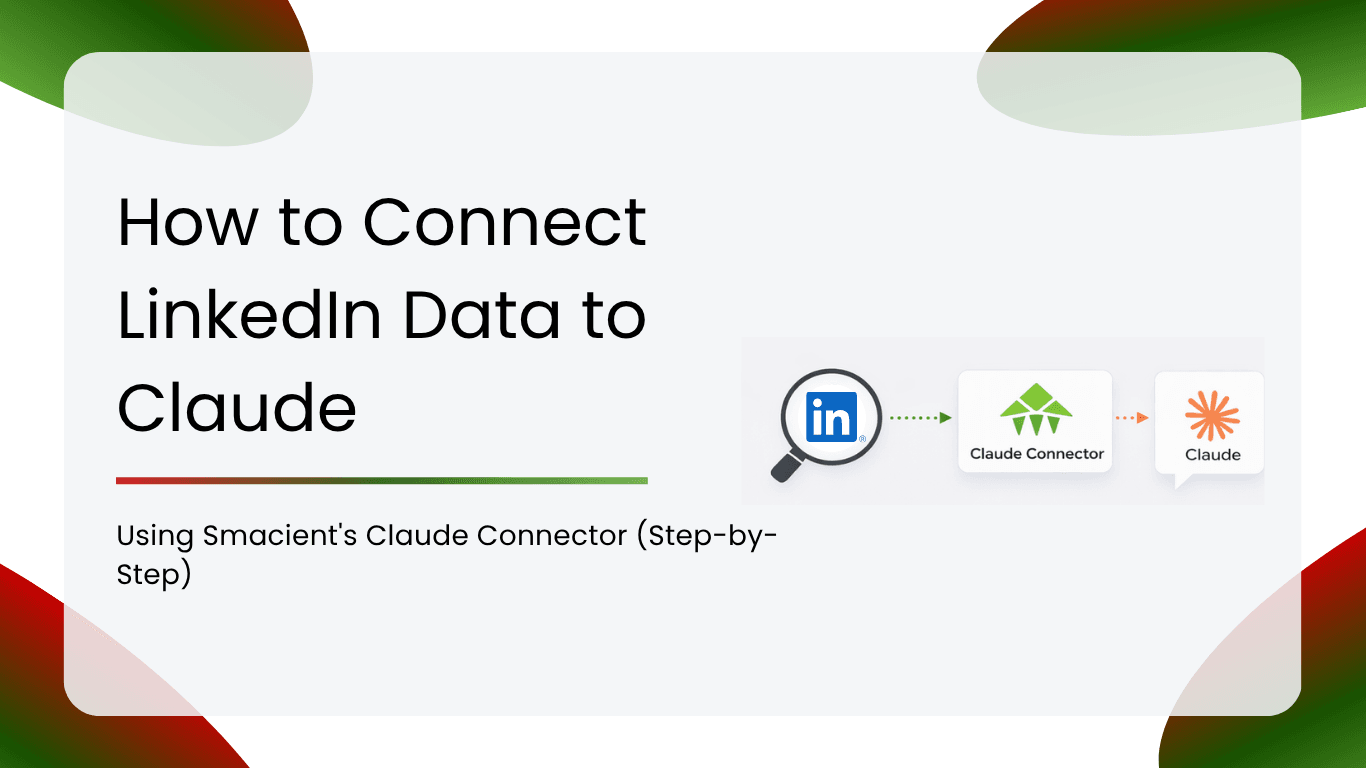
LinkedIn is the largest professional database in the world, but working with it has never matched its potential. Anyone who has built a prospect list knows the routine: run a search, scroll through results, open profiles in new tabs, squint at job titles, copy names and roles into a spreadsheet, then repeat the whole process again for company research on a completely different page. A single prospecting session can swallow an entire afternoon, and most of that time goes to mechanical clicking rather than actual thinking.
Smacient’s Claude connector for LinkedIn removes that mechanical layer entirely. Instead of switching between LinkedIn tabs and your notes, you describe what you want in plain English, and Claude handles the searching, extraction, and organisation inside a single conversation. You can find people by role and location, pull complete profile and company details, and analyse post engagement without ever opening LinkedIn yourself.
In this guide, you will learn exactly how to connect LinkedIn data to Claude, what the connector can do once it is live, and how to run real prospecting, competitor research, and outreach workflows with copy-ready prompts.
Try the tool: Smacient’s Claude Connector for LinkedIn lets you search LinkedIn profiles, extract company details, and analyse posts directly inside Claude. Start free with 30 monthly credits, no credit card required.
Table of Contents
What Is Smacient’s Claude Connector for LinkedIn?
The connector is an integration built by Smacient that gives Claude direct, on-demand access to publicly available LinkedIn data. Once you connect it, Claude gains a set of LinkedIn tools it can call whenever your request needs them. Ask Claude to find VP Engineering profiles at fintech companies in London, and it runs the search, formats the results, and presents them in the conversation with names, roles, companies, and follower ranges.
Three things make the approach different from every other way of getting LinkedIn data:
No Sales Navigator subscription. The connector does not require Sales Navigator, a LinkedIn API key, or even a LinkedIn account connection. There is nothing to link, authorise, or risk on the LinkedIn side.
No copy-pasting. Results arrive directly inside your Claude conversation. Because the data lives in the chat, you can immediately ask Claude to compare candidates, summarise themes, rank prospects, or draft outreach messages based on what it just pulled. The research and the analysis happen in the same place.
No browser extensions. Nothing gets installed in your browser, and nothing attaches to your LinkedIn session. Browser-based scrapers tie their activity to your personal account, which carries obvious risk. This connector operates independently of your account entirely.
The connector works with Claude.ai, Claude Desktop, Claude Code, and Claude Cowork. Any Claude client that supports custom connectors can run it, and it also plugs into agentic workflows where Claude chains multiple research steps together on its own.
What Is MCP and Why Does It Matter?
Under the hood, the connector runs on MCP, which stands for Model Context Protocol. It is an open standard that lets AI assistants like Claude connect to external tools and data sources. Think of it as a universal adapter: instead of Claude being limited to its training knowledge, connectors built on MCP give it live capabilities such as searching a database, reading a file system, or, in this case, pulling fresh LinkedIn data.
Why does this matter for LinkedIn research specifically? Because professional data goes stale fast. People change jobs, companies grow, and posts accumulate engagement. An AI model’s built-in knowledge cannot tell you who currently leads marketing at a specific SaaS company or what someone posted last Tuesday. A live connector can.
The practical upside is that you get the best of both worlds: Claude’s reasoning and language ability applied to data that is current as of the moment you ask. That combination is what turns “search LinkedIn for me” into “search LinkedIn, shortlist the five best fits, explain why, and draft a personalised opener for each.”
How to Connect LinkedIn Data to Claude in 5 Steps
The full setup takes under a minute. Here is the process from start to finish:
- Create a free Smacient account. No credit card is needed, and you get 30 free credits every month, which activate immediately.
- Copy the connector URL from your Smacient dashboard.
- Paste it into Claude Settings under custom connectors. Claude.ai Pro and Team plans, Claude Desktop, Claude Code, and Claude Cowork all support this.
- Sign in with your Smacient credentials when prompted to authorise the connection.
- Open a new conversation and test it with something like: “Find Heads of Marketing at SaaS companies in the SF Bay Area. Show me the top 5 with their roles and reach.”
If Claude returns a structured list of profiles, you are live. Note that one Smacient account unlocks their full set of Claude tools for marketers, not just LinkedIn, so the same connection covers their other platform integrations too.
The Old Way vs. the New Way
Here is what a typical prospecting task looks like with and without the connector:
| Task | Manual LinkedIn Research | Inside Claude with the Connector |
| Finding people | Search manually, scroll through pages of results one by one | One plain-English request returns structured results |
| Checking fit | Click into each profile individually to verify role and background | Preview names, roles, and reach in a single list |
| Recording details | Copy details into a doc or spreadsheet by hand | Data is already structured in the conversation |
| Company research | A separate manual process on a different LinkedIn page | Ask for company details in the same chat |
| Activity review | Scroll through someone’s activity feed post by post | Request their recent posts with engagement stats |
| Analysis | Do it yourself afterwards from your notes | Ask Claude to rank, compare, or summarise immediately |
The difference is not just speed. When research and analysis live in the same conversation, you stop losing context between steps. The profile you enriched two minutes ago is still right there when you ask Claude to draft an outreach message referencing that person’s recent post.
The Six Capabilities in Detail
1. Profile Search by Role and Location
This is the entry point for most workflows. You can search by job title, industry, location, or any combination of the three. Each search returns up to 30 results spread across multiple pages, and the top match is flagged automatically based on relevance to your query.
Every result includes the person’s name, current role, company, location, and a follower range, which gives you an immediate sense of their reach and seniority before you invest in the full details. This preview layer is what makes broad, exploratory searching practical: you can cast a wide net, scan the catch, and only pull in what fits.
2. Full Profile Enrichment
Once you have identified profiles worth a closer look, enrichment pulls the complete picture: headline, location, about section, current role, past experience, education history, top skills, languages, certifications, and open-to-work status. You can also request an exact or approximate follower count depending on how precise you need to be.
For sales teams, this is qualification data. For recruiters, it is a candidate snapshot. For partnership teams, it is the background check before a first call. Whatever the use case, the point is that everything a public profile shows is now structured data Claude can reason over, rather than a page you skim and half-remember.
3. Company Page Extraction
Company research usually means a separate, equally manual process. The connector folds it into the same conversation. Pull any company’s LinkedIn page, and you get the tagline, about section, website, industry, employee count, follower count, headquarters, and founding year.
Two extra details make this capability particularly useful for competitive work. First, you get the visible employee list with profile links, which means you can go straight from a company page to enriching the profiles of its key people. Second, you get similar companies that LinkedIn itself suggests, which is a fast way to expand a competitor set or build out a target account list from one seed company.
4. Single Post Analysis
Paste any public LinkedIn post URL, and Claude extracts the full post text, reaction count, comment count, the author’s name, headline, and follower count, plus the top five comments with commenter names.
This turns “why did this post do so well?” from a guess into an analysis. You can hand Claude a high-performing post from your niche and ask what structural elements, hooks, or topics likely drove the engagement, then apply those lessons to your own content. The commenter data is a bonus: the people engaging with a relevant post are often prospects themselves.
5. Recent Posts from Any Profile
For any public profile, the connector can fetch up to 20 recent posts, each with likes, comments, shares, post date, and media type. This is the single best input for outreach personalisation that exists.
Before messaging a prospect, ask Claude to pull their last 10 or 15 posts and summarise their content themes, their posting frequency, and which posts earned the most engagement. Now your opener can reference something they actually care about instead of a generic compliment about their company. The same capability works for evaluating influencers, vetting potential partners, or studying how a competitor’s executives position themselves publicly.
6. Search-to-Enrich Chained Workflows
The capabilities above are useful individually, but the real leverage comes from chaining them in one conversation. A single session can flow like this: search for profiles, review the previews, enrich the three best fits, pull the company page for the most promising one, fetch that person’s recent posts, and finish by asking Claude to draft a personalised outreach message that references their latest content.
That entire sequence, which would take hours of tab-switching and note-taking manually, happens as a natural back-and-forth conversation. And because Claude retains the context, every later step builds on everything gathered earlier.
Real Workflows with Example Prompts
Here are three workflows teams run with the connector, including prompts you can copy and adapt.
Lead List Building Without Manual Search
The goal: a qualified target list without wasting effort on irrelevant profiles.
“Search for Heads of Growth at D2C brands in Bangalore. Show me the results, and I will tell you which ones to pull full details for.”
Review the previews, name the profiles that fit, and let Claude enrich only those. Then follow up with something like “Rank these three by seniority and summarise each person’s background in two sentences.” Smacient estimates this saves around 3 hours per prospecting session, and the bigger win is that your list arrives pre-analysed rather than as raw rows in a spreadsheet.
Competitor Hiring and Positioning Research
The goal: understand how a competitor is building their team and where they sit in the market.
“Pull the LinkedIn company page for [competitor]. Show me their employee count, visible team members, and which similar companies LinkedIn suggests.”
From there, enrich the profiles of their visible senior hires to gauge what kind of talent they are bringing in. The similar-companies list doubles as a map of your competitive landscape as LinkedIn’s own algorithm sees it. Roughly 2 hours are saved per research session, and the output is a briefing rather than a pile of screenshots.
Outreach Prep and Content Research
The goal: walk into every outreach message or first call already knowing what the other person cares about.
“Get the last 10 posts from this profile: [LinkedIn URL]. What topics do they cover most, and which post got the highest engagement?”
Follow up by asking Claude to draft an opener that references their most engaged post. For content research, run the same analysis on several top creators in your niche and ask Claude to identify the patterns across their highest-performing posts. About 1 hour is saved per prep session, and your messages stop sounding like templates.
How the Preview-First Design Protects Your Credits
The connector runs on a credit system, and its smartest design decision is that searching and enriching are separate steps. A search returns lightweight previews: enough information (name, role, company, location, follower range) to judge fit, but not the full profile.
Full enrichment only happens for the profiles you explicitly choose. In practice, this means a broad, exploratory search across 30 results costs almost nothing, and you spend meaningfully only on the handful of profiles that survive your review. You are never charged for data you did not want, and your Smacient dashboard shows exact costs before and after each call, so there are no surprises.
The free tier includes 30 credits every month with no credit card required, which is enough to run real workflows and decide whether the tool fits your process before committing to anything.
Data Access and Privacy
Two boundaries are worth stating clearly because they answer the compliance questions that come up in most teams.
The connector only accesses public data. Everything it extracts (profiles, company pages, posts, comments) is information visible to anyone viewing the page without being logged in or connected. Private profiles, restricted content, and anything behind LinkedIn’s connection wall are not accessible, full stop.
Your LinkedIn account is never involved. Because no LinkedIn login or API key is required, none of the connector’s activity is associated with your personal or company account. This is a meaningful difference from browser extensions and automation tools that operate through your own session.
FAQs
No. The connector requires no Sales Navigator subscription, no LinkedIn API key, and no LinkedIn account connection of any kind. It extracts publicly available data from profiles, company pages, and posts independently of any account.
No. The connector only pulls publicly visible data, meaning the same information anyone can see when viewing a page without being connected. Private and restricted profiles are simply not accessible to it.
Searches return lightweight previews first so you can review names, roles, and reach before spending credits on full enrichment. You then tell Claude exactly which profiles to enrich, which keeps costs efficient even when you search broadly and cast a wide net.
It works with Claude.ai (Pro and Team plans support custom connectors), Claude Desktop, Claude Code, and Claude Cowork. Any Claude client with MCP support will run it, including agentic setups where Claude chains multiple research steps automatically.
The connector pulls live data at the moment you ask, not cached or pre-scraped records. If someone changed jobs last week or published a post this morning, that is what you will see, which is exactly what makes it more reliable than any AI model’s built-in knowledge for professional research.
Related Blogs
- How to Extract Google Play Store Data into Google Sheets
- How to Extract Apple App Store Data into Google Sheets (No Code)
- How to Extract YouTube Channel Data and Comments in Google Sheets
- How to Connect Instagram Data to Claude (No API Needed)
- How to Connect GSC Data to Claude in Under 1 Minute for Free