
Amazon reviews are packed with insights into what customers love, dislike, and want improved. But going through hundreds or thousands of reviews manually isn’t exactly practical.
Claude can help turn this messy review data into useful insights, from recurring complaints and product strengths to feature requests and purchase drivers. With an Amazon MCP server or Claude Connector, Claude can connect to external Amazon data sources, making it easier to search products, collect reviews, and analyze customer feedback using natural-language prompts.
In this guide, we’ll compare the top tools based on review extraction, analysis capabilities, Claude/Connector compatibility, Amazon marketplace coverage, setup, and pricing.
Quick Answer: Best Amazon MCP Servers and Review Tools
| Tool | Review Extraction | Claude/MCP support | Pricing |
| Smacient Amazon Claude Connector | Yes | Yes | Free tier + credit-based |
| VOC Amazon Reviews MCP | Yes | Yes | Paid |
| Apify Amazon Review Scraper + Apify MCP | Yes | Yes | Usage-based |
| Amazon Review Analyzer / Amazon-Skills | Not built-in | Yes | Free / OSS |
| Bright Data Amazon MCP | Yes | Yes | Usage-based |
| Amazon Review Analyzer Chrome Extension | Yes | Yes | Free |
How We Ranked These Claude Amazon Reviews Tools
We evaluated each tool based on the factors that matter when using Claude for Amazon review research:
- Amazon data access: How reliably the tool can retrieve Amazon reviews, product information, and related marketplace data.
- Review analysis capabilities: Whether it supports sentiment, themes, complaints, feature requests, and other qualitative insights.
- Amazon marketplace coverage: Number of Amazon marketplaces supported.
- Claude/Connector compatibility: How easily the tool works with Claude through MCP or a Claude Connector.
- Data freshness and depth: Whether the tool provides current reviews and useful review-level details such as ratings, dates, helpful votes, and review text.
- Setup difficulty: How much technical configuration is required to get started.
- Pricing: Free tiers, usage-based pricing, subscriptions, or self-hosted costs.
- Use-case fit: How useful the tool is for marketers, Amazon sellers, product teams, and agencies.
Comparison Table: Mining Amazon Reviews with Claude: The Top Tools
| Tool | Review Focus | Best For | Setup Difficulty |
| Smacient Amazon Claude Connector | High | Amazon product and review research with Claude | Easy |
| VOC Amazon Reviews MCP | High | Voice-of-customer analysis | Easy |
| Apify Amazon Review Scraper + MCP | High | Large-scale review extraction | Easy to medium |
| Amazon Review Analyzer / Amazon-Skills | High | AI-assisted review analysis | Medium |
| Bright Data Amazon MCP | High | Large-scale Amazon data extraction | Medium |
| Amazon Review Analyzer Chrome Extension | High | Quick review analysis with Claude | Easy |
Mining Amazon Reviews with Claude: The Top Tools
1. Smacient Amazon Claude Connector
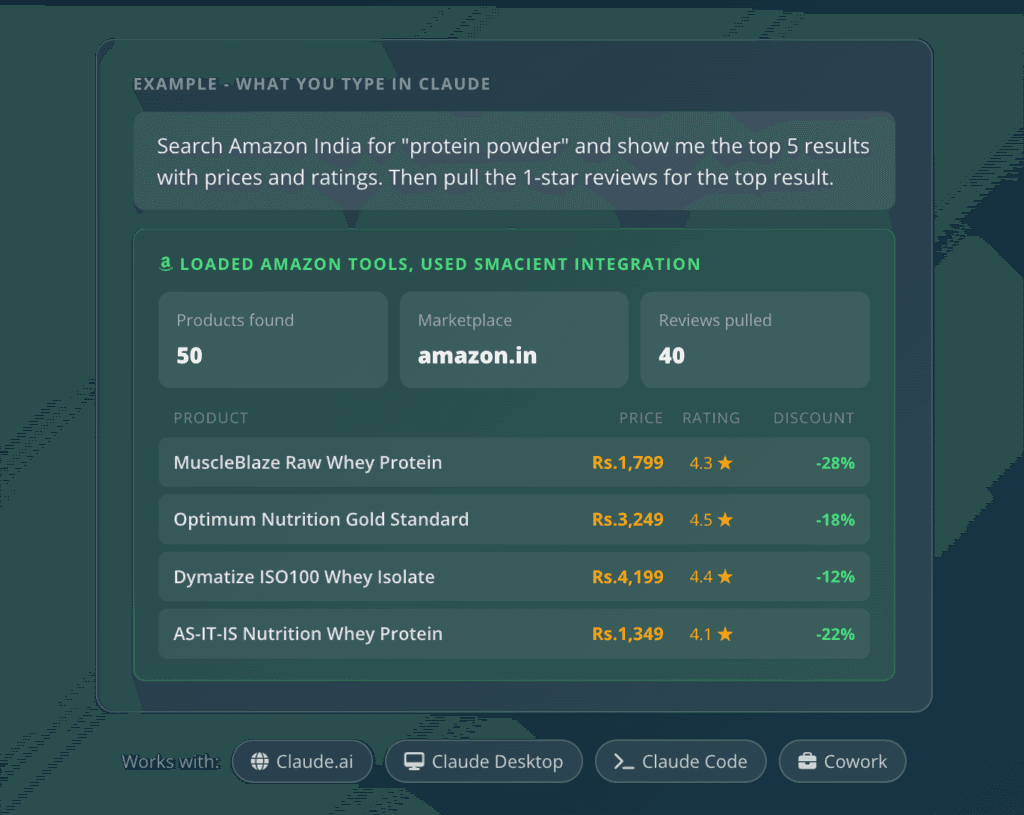
Smacient’s Amazon Claude Connector lets you search Amazon products and pull review data into Claude using natural-language prompts. Instead of manually searching for products, copying ASINs, and going through individual reviews, you can ask Claude to find products by keyword or brand, compare pricing and review counts, and then pull reviews for the products you want to research. Reviews can be filtered by star rating, verified purchase status, or specific keywords, making it easier to focus on the feedback that matters. The connector supports nine Amazon marketplaces and lets you move from product discovery to review analysis within the same Claude conversation. This makes it useful for competitor research, voice-of-customer analysis, listing research, and broader Amazon market research.
Key Features:
- Amazon product search: Search Amazon by keyword or brand name and discover relevant products directly through Claude.
- Product data extraction: Pull product titles, ASINs, current prices, list prices, discount percentages, ratings, review counts, and monthly sales volume.
- Product visibility signals: Identify sponsored, Prime, and Amazon’s Choice products in search results.
- Review extraction: Pull Amazon reviews using an ASIN or full Amazon product URL, including review ratings, titles, review text, verified purchase status, helpful votes, and dates.
- Review filtering: Filter reviews by 1 to 5 star rating, verified-purchase status, or specific keywords.
- Review sorting: Sort reviews by most recent or most helpful to focus on the feedback most relevant to your research.
- Multi-ASIN research: Pull reviews for up to five ASINs in a single call, making competitor comparisons easier.
- Nine Amazon marketplaces: Search and extract data across Amazon US, UK, India, Germany, France, Spain, Italy, Japan, and Australia.
- Pricing and discount intelligence: Compare current prices, list prices, and discount percentages across products and identify competitors running promotions.
- Search-to-review workflow: Search for products, find relevant ASINs, and pull their reviews in the same Claude conversation without manually copying ASINs between steps.
- Natural-language Claude workflow: Ask Claude to search, filter, compare, and summarize Amazon product and review data without switching between multiple tools.
- 30 free credits every month: New users get 30 free credits each month with no credit card required, giving them access to Smacient’s Amazon tools before purchasing additional credits.
Cons:
- Credit-based usage: The connector uses credits for Amazon product searches and review extraction, so costs depend on how much data you pull.
- Review volume limits: Individual review calls can return up to 150 reviews per product, with up to five ASINs supported in a single call.
- Primarily Amazon-focused: Users looking for broader Seller Central, advertising, or operational data may need additional tools.
Why Choose It:
Choose Smacient’s Amazon Claude Connector if you want to move from Amazon product discovery to review analysis in one Claude workflow. It is particularly useful for marketers and sellers who need to compare products, filter customer feedback, research competitors, and turn Amazon review data into actionable insights without manually collecting ASINs or copying reviews into spreadsheets.
2. VOC Amazon Reviews MCP
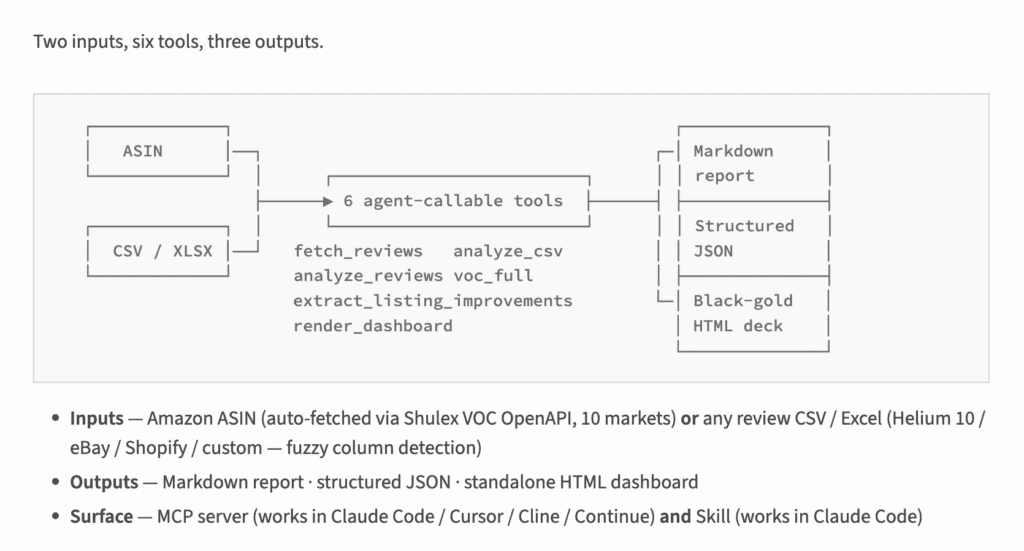
VOC Amazon Reviews MCP connects Claude-compatible AI clients with Amazon review data, allowing you to analyze customer feedback without manually going through hundreds of reviews. You can provide an ASIN to fetch Amazon reviews and use the available tools to identify sentiment, recurring complaints, customer pain points, and product strengths. It also supports analyzing review data from CSV and Excel files, making it useful when you already have feedback from other sources. For sellers focused on improving their Amazon listings, it can generate listing improvement suggestions based on customer language. The project currently supports Amazon review retrieval across 10 markets.
Key Features:
- Review extraction: Fetches Amazon reviews by ASIN through the Shulex VOC OpenAPI.
- Sentiment analysis: Analyzes reviews to identify positive and negative customer sentiment.
- Pain-point detection: Highlights recurring complaints and customer issues across reviews.
- Listing optimization: Generates suggestions for improving titles, bullets, and descriptions using customer feedback.
- Review file analysis: Supports CSV and Excel files containing review data from other sources.
- Marketplace support: Retrieves Amazon reviews across 10 supported markets.
Cons:
- Requires an API key: A Shulex VOC API key is required to fetch Amazon review data.
- Technical setup: The MCP server requires some configuration, including installing the required environment/tooling.
- Additional API requirement for listing improvements: The listing-improvement tool requires an Anthropic API key because it directly calls Claude.
Why Choose It:
Choose VOC Amazon Reviews MCP if you want to go beyond simply collecting Amazon reviews and actually turn them into voice-of-customer insights. Its combination of review extraction, sentiment and pain-point analysis, and listing recommendations makes it particularly useful for sellers looking to turn customer feedback into product and marketing decisions.
3. Apify Amazon Review Scraper + Apify MCP
Apify offers multiple Amazon review-scraping Actors that can extract customer feedback from Amazon product pages. Depending on the Actor, you can collect review text, ratings, dates, verified-purchase information, helpful votes, images, and other metadata. The extracted results can be made available to Claude through Apify’s MCP server for analysis, summaries, sentiment analysis, competitor research, and custom-insight workflows. Apify also supports structured outputs such as JSON, CSV, and Excel, making the data useful beyond Claude.
Key Features:
- Amazon review extraction: Scrapes review text, ratings, titles, dates, and other customer feedback from Amazon products.
- Rich review data: Depending on the Actor, captures verified-purchase status, helpful votes, images, reactions, and other metadata.
- MCP integration: Lets Claude and other MCP-compatible AI clients discover and run Apify Actors and retrieve their results.
- Structured exports: Review data can be exported in different formats, depending on the Actor.
- Scalable workflows: Multiple Actors support review collection across products and Amazon marketplaces, making them useful for competitor research and larger review datasets.
Cons:
- Actor selection can be confusing: Apify has multiple Amazon review Actors with different features, pricing, maintenance status, and marketplace coverage.
- Usage-based costs: Pricing varies by Actor and review volume; for example, current review-scraper listings range from under $1 to several dollars per 1,000 reviews.
- Setup required: You’ll need an Apify account and authentication to run Actors through the MCP server. Apify currently recommends its hosted MCP server with OAuth for the simplest setup.
Why Choose It:
Choose Apify if you need flexible, large-scale Amazon review extraction rather than a dedicated review-analysis tool. Its MCP integration lets you bring the resulting data into Claude for deeper analysis, making it particularly useful when you want control over both the review dataset and the AI workflow.
4. Amazon Review Analyzer / Amazon-Skills
Amazon Review Analyzer is a dedicated skill within Nexscope’s Amazon-Skills collection, built to turn customer reviews into product and marketing insights. It can analyze sentiment patterns, recurring complaints, feature requests, and competitive insights from Amazon reviews. The skill works with Claude Code and other compatible AI agents, allowing users to ask natural-language questions about customer feedback. It is particularly useful for identifying the problems customers repeatedly mention and turning those findings into product-improvement or marketing opportunities. However, the skill itself does not provide live Amazon data, so review data access may need to come from another source or workflow.

Key Features:
- Sentiment analysis: Identifies positive and negative patterns across customer feedback.
- Complaint mining: Finds recurring customer complaints and ranks important issues.
- Feature requests: Extracts product features and improvements customers ask for.
- Competitive insights: Identifies competitor strengths, weaknesses, and potential market gaps from available review data.
- AI-agent workflow: Works with Claude Code, Cursor, Windsurf, Codex, and other compatible agents.
Cons:
- Beta status: The Amazon Review Analyzer is currently listed as a Beta skill.
- No live data access: The skill itself doesn’t provide live Amazon marketplace data, so you’ll need an appropriate data source to analyze actual reviews.
- More technical than a standalone tool: Installation involves adding the skill to your AI-agent environment.
Why Choose It:
Choose Amazon Review Analyzer if you want an open-source, AI-first approach to interpreting review data rather than a traditional scraping tool. It’s especially useful for extracting complaints, feature requests, and competitive insights once the review data is available to the agent.
5. Bright Data Amazon MCP
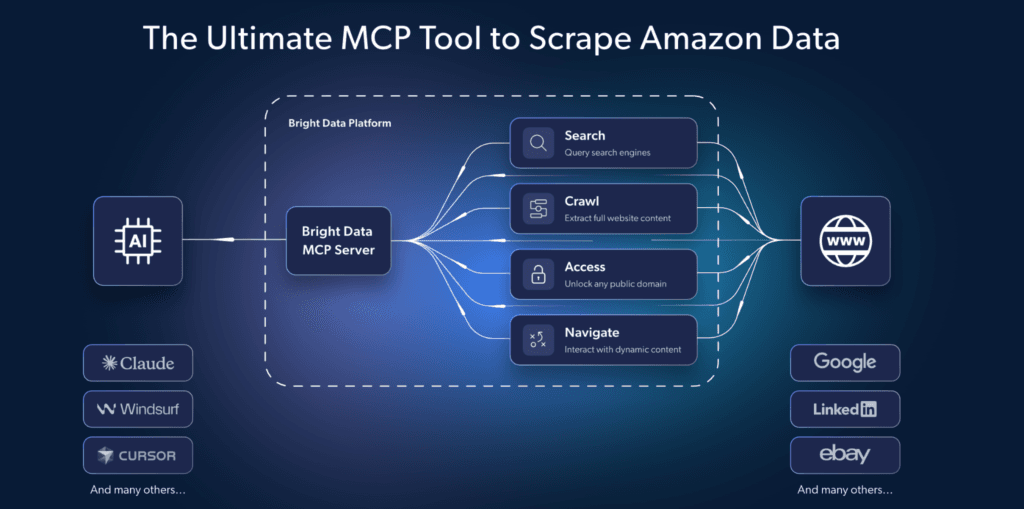
Bright Data’s Amazon MCP Server gives AI assistants access to public Amazon data through the Model Context Protocol. For review mining, it can retrieve Amazon product reviews as structured data, allowing users to collect review information and analyze it through an AI workflow. Its dedicated Amazon Reviews Scraper can capture fields such as review text, ratings, dates, reviewer information, ASINs, and verified-purchase status. Bright Data is particularly useful for larger-scale research because its infrastructure is designed for automated web data extraction and handles challenges such as blocking and CAPTCHA protection.
Key Features:
- Amazon review extraction: Retrieves structured Amazon review data including ratings, review text, dates, ASINs, and other metadata.
- Amazon MCP integration: Lets MCP-compatible AI clients access Amazon data through Bright Data’s MCP server.
- Real-time data: Designed for live Amazon data extraction rather than relying solely on a pre-collected dataset.
- Large-scale scraping: Supports bulk extraction and high-volume Amazon data workflows.
- Broader Amazon research: Beyond reviews, the MCP can retrieve product and pricing information, making it useful for competitive research alongside review analysis.
Cons:
- More technical than dedicated review tools: Bright Data is primarily a web-data infrastructure platform, so configuring advanced workflows may require more technical knowledge.
- Usage-based pricing: The MCP has a free tier of 5,000 monthly requests, after which pricing is usage-based; the current pay-as-you-go rate is $1.50 per 1,000 results.
- Broader than reviews: If you only need simple review analysis, a dedicated review-focused MCP may offer a more straightforward workflow.
Why Choose It:
Choose Bright Data if you need reliable Amazon review extraction at scale and want to combine reviews with broader product, pricing, and marketplace research. Its Amazon MCP makes it particularly relevant for teams building more extensive AI-powered research workflows.
6. Amazon Review Analyzer Chrome Extension
Amazon Review Analyzer is a Chrome extension that analyzes customer reviews directly from Amazon product pages using Claude AI. It can read recent and helpful reviews and generate an overall sentiment score, pros and cons, recurring issues, red flags, and a concise summary of customer feedback. It also provides alternative-product suggestions based on the analysis. Since the analysis happens directly from the Amazon browsing experience, it offers a much simpler workflow than setting up a dedicated scraping pipeline or MCP server.
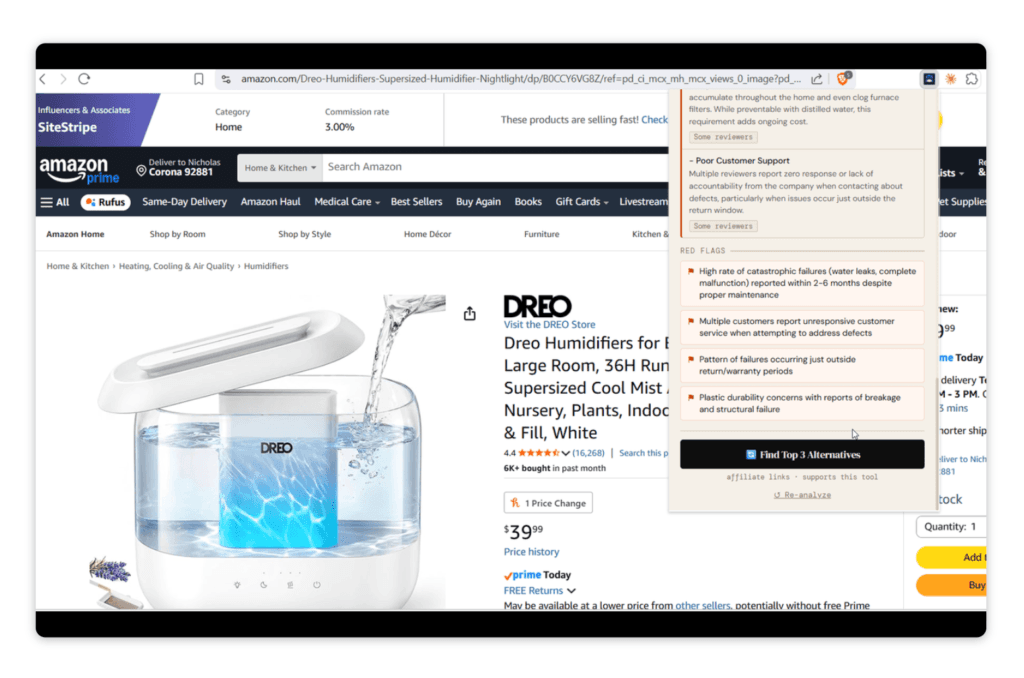
Key Features:
- AI review analysis: Uses Claude to analyze Amazon customer reviews.
- Sentiment scoring: Generates a 0-100 sentiment score based on review patterns.
- Pros and cons: Identifies frequently mentioned strengths and weaknesses.
- Red-flag detection: Surfaces recurring defects, quality issues, or potentially misleading product claims.
- Quick summaries: Turns multiple reviews into a short, actionable product assessment.
- No account required: The extension can analyze reviews directly from the Amazon product page without requiring users to create an account.
Cons:
- Not an MCP: It doesn’t provide the same Claude connector workflow as the other MCP tools in this list.
- Limited review volume: It can analyze up to just 30 reviews across multiple pages.
- Chrome-specific: You need to use the browser extension rather than connecting it to a broader AI workflow.
Why Choose It:
Choose this if you want quick Amazon review insights with minimal setup. It’s particularly useful for competitor research and product evaluation when you don’t need bulk extraction or a full MCP-based workflow.
What Can You Actually Do With Amazon Reviews in Claude?
Once Amazon product and review data is available in Claude, you can use it for much more than simply summarizing reviews.
1. Find Relevant Products and Competitors
Search Amazon by keyword or brand to identify competing products, compare their prices, ratings, review counts, and discounts, and then move directly into review research.
2. Find Recurring Customer Complaints
Identify problems that customers mention repeatedly, from product quality issues to common frustrations, instead of digging through reviews one by one.
3. Analyze Positive vs. Negative Sentiment
See what customers consistently love about a product and what is causing dissatisfaction. You can also filter reviews by star rating to focus specifically on positive or negative feedback.
4. Identify Product Improvement Opportunities
Turn recurring complaints, feature requests, and customer suggestions into actionable ideas for improving the product or customer experience.
5. Improve Amazon Listings
Use the language customers naturally use in their reviews to make your listings more relevant and persuasive. This can help improve:
- Product titles
- Bullet points
- Product descriptions
- A+ content
- Product positioning
6. Analyze Competitor Reviews
Compare reviews across multiple competing products to see where customers prefer one product over another and identify gaps your product or listing could address.
7. Find Emerging Customer Trends
Track recurring complaints, feature requests, and changing customer expectations across products and over time to identify emerging customer needs.
8. Generate Customer Personas and Pain Points
Analyze review datasets to understand who is buying a product, what they care about, what problems they face, and what ultimately influences their purchase decision.
Which Tool Should You Choose?
| Tool | Choose it if… |
| Smacient Amazon Claude Connector | You want to search Amazon products, extract reviews, and analyze customer feedback with Claude in one workflow. |
| VOC Amazon Reviews MCP | You primarily need review intelligence and voice-of-customer analysis. |
| Apify Amazon Review Scraper + Apify MCP | You want flexible, large-scale review extraction and control over the raw dataset. |
| Amazon Review Analyzer / Amazon-Skills | You want an AI-first, open-source approach to analyzing review data. |
| Bright Data Amazon MCP | You need large-scale Amazon review extraction with broader product and marketplace data. |
| Amazon Review Analyzer Chrome Extension | You want quick Amazon review insights with minimal setup directly in your browser. |
Mining Amazon reviews with Claude can turn thousands of customer opinions into actionable insights without requiring marketers to read every review manually. The right tool depends on whether you need dedicated review intelligence, flexible scraping, AI-assisted analysis, or broader Amazon product and marketplace research.
Ultimately, choose the tool that matches the depth of data, level of automation, and type of analysis your workflow requires.
Explore our other Amazon and AI web scraping guides here:
- 11 Best Amazon Scrapers
- Extract Amazon Reviews Data into Claude with Smacient
- 10 Best AI Web Scraping Tools
FAQs
Not by itself. An MCP server or Claude Connector acts as the connection layer between Claude and an external Amazon data source. For example, Smacient’s Amazon Claude Connector lets Claude search Amazon products and pull review data directly into the conversation.
It depends on the tool and its data source. Some Amazon review tools allow you to retrieve reviews using an ASIN, while others may have marketplace, product, or access limitations. Smacient’s Amazon Claude Connector supports review extraction by ASIN or full Amazon product URL.
Freshness varies by tool. Scrapers and live data connectors can retrieve currently available reviews, while API-based or stored datasets may have different update schedules.
Yes. Once review data is available to Claude, you can ask it to identify positive and negative sentiment, recurring complaints, common themes, and other patterns. Smacient’s Amazon Claude Connector can bring Amazon review data directly into Claude, where you can use natural-language prompts to analyze the feedback.
Disclosure – This post contains some sponsored links and some affiliate links, and we may earn a commission when you click on the links, at no additional cost to you.