You finally set up your scraper. It’s running smoothly, pulling clean data, and everything looks perfect. Suddenly, requests start failing. Some pages won’t load, and data becomes inconsistent. As a result, your scraper goes painfully slow or is completely blocked.
If you’ve been there, you’ve probably wondered: “Do I need better proxies, or just different ones?”
Should you go with residential proxies that mimic real users? Or are ISP proxies the better choice for stability and speed?
In this blog, we’ll break it down:
- What ISP proxies actually are
- How they compare to residential proxies
- And most importantly, when each one works best for scraping
Table of Contents
What are ISP Proxies?
ISP proxies are residential IP addresses that are hosted on a datacenter infrastructure. Let’s break that down in a way that makes sense:
- Residential proxies —–> IPs from real user devices (harder to detect, but can be slower or less stable)
- Datacenter proxies —–> IPs from servers (fast and reliable, but easier to block)
- ISP proxies —–> a hybrid of both
Key Characteristics of ISP Proxies
Here’s what makes them stand out:
Residential-Looking IPs
Even though they’re hosted on servers. ISP proxies are registered under Internet Service Providers. That makes them appear like genuine user connections to most websites.
Datacenter-Level Speed
Since they run on powerful servers, ISP proxies are significantly faster and more stable than traditional residential proxies.
Static/Sticky Sessions
Unlike rotating residential IPs, ISP proxies usually stay the same for longer sessions. This is ideal when you need consistency, like logging into accounts or maintaining sessions.
High Trust Score
Because they combine real ISP registration with clean infrastructure, ISP proxies are less likely to trigger blocks or CAPTCHAs compared to standard datacenter proxies.
ISP vs Residential Proxy: Key Differences
| Feature | ISP Proxy | Residential Proxy |
| IP Source | ISP-issues (datacenter hosted) | Real user devices |
| Speed | High (datacenter-grade) | Medium |
| Stability | Very stable (static IPs) | Can fluctuate |
| Rotation | Limited/optional | Large rotating pools |
| Datacenter Risk | Low | Very low |
| Cost Model | Often fixed/unlimited | Per GB pricing |
| Best For | Long sessions, login flows | Large-scale rotation |
If your scraper needs to behave like one reliable user, ISP proxies are the better fit.
If your scraper needs to behave like thousands of different users, residential proxies win.
How ISP Proxies Work
At a basic level, the flow looks like this:
Your Requests —–> ISP Proxy Server —–> Target Website —–> Response Back to You
What’s Actually Happening Here?
When you send a request, it doesn’t go directly from your system to the website.
Instead, it’s routed through an ISP proxy server first.
That proxy then forwards your request to the target site, but here’s the key part:
The website sees the request coming from a residential-looking IP, not from you.
Why This Matters for Scraping
IP Masking
Your original IP stays hidden. The target site only sees the ISP-assigned IP, which looks like a normal user browsing the site.
Real User Appearance
Because the IP is registered with an Internet Service Provider, the traffic appears legitimate, just like someone accessing the site from home.
Stable Infrastructure
Even though it looks like residential traffic, it’s actually running through datacenter-grade servers. That means:
- Faster response times
- Fewer dropped requests
- More consistent performance
The Big Advantage
You’re essentially getting the illusion of real user traffic, backed by the reliability of server infrastructure.
That combination is what makes ISP proxies especially powerful for tasks where both trust and stability matter.
When to Use ISP Proxies
Here’s why they shine the most:
Long Sessions & Account-Based Scraping
Think of platforms where you need to stay logged in. With rotating IPs, sessions often break. You get logged out, re-authentication kicks in, and your scraper slows down or fails.
Why ISP Proxies Win Here:
They offer static IP stability, so your session stays consistent. That means:
- Fewer login interruptions
- Smooth session persistence
- No repeated authentication loops
High-Speed Scraping with Low Block Risk
If you’ve used residential proxies, you know they can sometimes feel slow or inconsistent.
Datacenter proxies are fast, but they get flagged quickly.
ISP proxies sit right in the middle.
Why They Work:
- Faster than residential proxies
- Less detectable than datacenter proxies
Rate-Limit Bypass with Consistency
Many websites track behavior patterns, not just IPs. If your scraper keeps switching IPs too frequently, it can actually look more suspicious.
Why ISP Proxies Help:
- You don’t need constant IP rotation
- Requests come from a consistent identity
- Patterns look more natural
SEO Monitoring & SERP Tracking
Tracking search rankings or analyzing SERPs requires more than just access. You need:
- Accurate location targeting
- Consistent identity across requests
With rotating IPs, results can vary too much.
Why ISP Proxies Fit Perfectly:
They maintain a stable identity while still appearing as legitimate residential traffic, making your data more reliable.
Social Media & Multi-Account Management
Social platforms are extremely sensitive to IP behavior. If multiple accounts suddenly log in from constantly changing IPs, that’s a red flag.
Why ISP Proxies are Ideal:
- Each account can have a stable, consistent IP
- Looks like a real user operating from one location
- Reduces the risk of bans or verification triggers
When Residential Proxies are Better
There are situations where residential proxies clearly outperform ISP proxies, especially when scale and stealth matter more than stability.
Massive Scale Scraping
If your project involves sending thousands of requests, you’ll need access to a large pool of IPs.
Why Residential Wins:
- Huge rotating IP networks
- Ability to distribute requests across many identities
- Lower chance of hitting limits on a single IP
Heavy Anti-Bot Environments
Some websites are extremely aggressive with their detection systems, like ticketing platforms, sneaker sites, or high-security marketplaces.
Why Residential Wins:
- IPs come from real user devices
- Traffic blends in more naturally
- Even advanced detection systems struggle to flag them consistently
Frequent Rotation Requirements
In certain scraping setups, staying on one IP is actually a disadvantage. If you’re hitting endpoints repeatedly, you’ll need to keep changing identities to avoid blocks.
Why Residential Wins:
- Automatic, large-scale IP rotation
- Every request can come from a different user
- Reduces pattern detection
Geo-Diversity Across Multiple Regions
If your use case requires data from multiple countries, cities, or even ISPs, flexibility becomes critical.
Why Residential Wins:
- Wide geographic coverage
- Easy switching between regions
- Better for localized data collection at scale
ISP vs Residential Proxy: Decision Framework
At this point, the comparison is clear, but let’s make it even simpler:
Use ISP Proxies if:
- You need session stability
- You’re scraping logged-in platforms or account-based systems
- You want speed + reliability without frequent IP switching
Use Residential Proxies if:
- You need a large-scale rotation across many IPs
- You’re scraping heavily protected targets with strict anti-bot systems
- You require broad geo coverage across multiple regions
A Smarter Setup
A common and effective approach looks like this:
ISP Proxies —–> Login & Session Handling
- Maintain stable sessions
- Avoid repeated logins
- Build a trusted identity with the platform
Residential Proxies —–> Data Extraction at Scale
- Rotate across large IP pools
- Handle high-volume requests
- Reduce detection during bulk scraping
What This Achieves
By splitting responsibilities, you get the best of both worlds:
- Stability where it matters (sessions, accounts)
- Scale where it matters (data collection)
- Lower overall detection risk
- Better performance across the pipeline
How Decodo Can Be Used
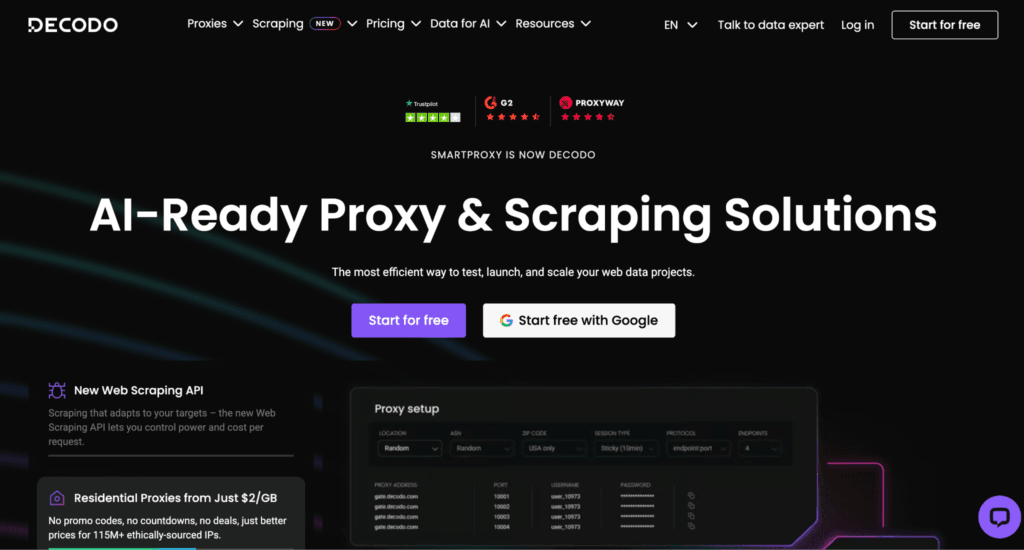
The real advantage comes from being able to switch between both seamlessly. That’s where providers like Decodo come into the picture.
Instead of managing separate tools or setups, platforms like Decodo offer:
- ISP proxies for stable, high-trust sessions
- Residential proxy pools for large-scale rotation
- Hybrid flexibility to adapt based on your scraping needs
Why This Matters in Practice
As your scraping setup evolves, your requirements won’t stay the same. You might start with simple data collection, but quickly move into:
- Logged-in scraping
- Multi-account workflows
- High-volume extraction across regions
Managing all of this manually can get messy.
Providers like Decodo simplify this by letting you shift between ISP and residential strategies without rebuilding your entire pipeline.
The Practical Advantage
It’s less about the provider itself and more about what it enables:
- Flexibility to scale when needed
- Stability when sessions matter
- A smoother workflow without constant reconfiguration
Common Mistakes to Avoid
Here are some of the most common mistakes and how to avoid them:
Use ISP Proxies for High-Rotation Tasks
ISP proxies are built for stability, not constant switching. If you try to use them for high-volume scraping that requires frequent IP changes, you’ll:
- Hit limits faster
- Increase detection risk
- Waste resources on a setup that isn’t optimized for scale
Fix: Use residential proxies when your workflow depends on heavy rotation.
Using Residential Proxies for Login-Heavy Flows
Residential proxies rotate frequently, which is great for scale, but not for sessions. If you’re logging into accounts or maintaining sessions, this can lead to:
- Repeated logouts
- Verification triggers
- Broken workflows
Fix: Use ISP proxies for anything that requires consistent identity and session persistence.
Ignoring IP Reputation
Not all IPs are equal. Even the right proxy type can fail if the IP itself has a poor reputation. This often shows up as:
- Unexpected CAPTCHAs
- Sudden blocks
- Inconsistent scraping results
Fix:
- Use clean, high-quality IP pools
- Monitor performance regularly
- Rotate or replace IPs when issues appear
By now, one thing should be clear: ISP vs residential proxies isn’t really a competition.
It’s about:
- Choosing the right fit for your use case
- Designing your infrastructure in a way that supports both stability and scale
ISP proxies give you consistency, speed, and session reliability. Residential proxies give you rotation, stealth, and global reach.
The real advantage comes when you understand where each one fits and use them accordingly.
That’s also why providers like Decodo are becoming more relevant. They make it easier to move between ISP and residential strategies without constantly reworking your setup.
If you want to go deeper, check out our other proxy guides:
FAQs
Most scraping tools and scripts allow proxy configuration through a simple endpoint (IP:port or authentication-based URL). You route your requests through the ISP proxy, and it handles IP masking while maintaining a stable session.
It depends on your use case. For login-based or session-heavy tasks, even 1-5 ISP proxies can be enough. For larger workflows, you may need more, but ISP setups typically require fewer IPs than residential ones.
They can, especially on platforms with aggressive anti-bot systems. While ISP proxies have a lower detection risk than datacenter proxies, highly protected sites may still require residential proxies or a hybrid setup.
There’s no fixed number; it varies by website. A good starting point is slow and steady, then gradually increase while monitoring for blocks or CAPTCHAs. Consistency usually works better than aggressive request bursts.
Disclosure – This post contains some sponsored links and some affiliate links, and we may earn a commission when you click on the links, at no additional cost to you.